

Assam is one of India’s richest biodiversity hotspots and is known for its vast forests, wetlands, grasslands and riverine ecosystems. The state is home to 7 national parks, each offering a unique combination of wildlife, landscapes and ecological importance.
The National Parks of Assam are especially famous for the one-horned rhinoceros, Bengal tiger, Asian elephant, wild water buffalo, golden langur, hoolock gibbon and several rare species of birds.
From the very famous Kaziranga National Park to the relatively newer Raimona National Park, these protected areas play an important role in conserving Assam’s remarkable biodiversity.
How Many National Parks Are There in Assam?
Assam has seven national parks: Kaziranga, Manas, Nameri, Dibru-Saikhowa, Orang, Dehing-Patkai and Raimona. Three of these — Kaziranga, Manas, and Nameri — also carry Tiger Reserve status, and two, Kaziranga and Manas, are UNESCO World Heritage Sites. Raimona is the newest addition, carved out and declared in 2021.
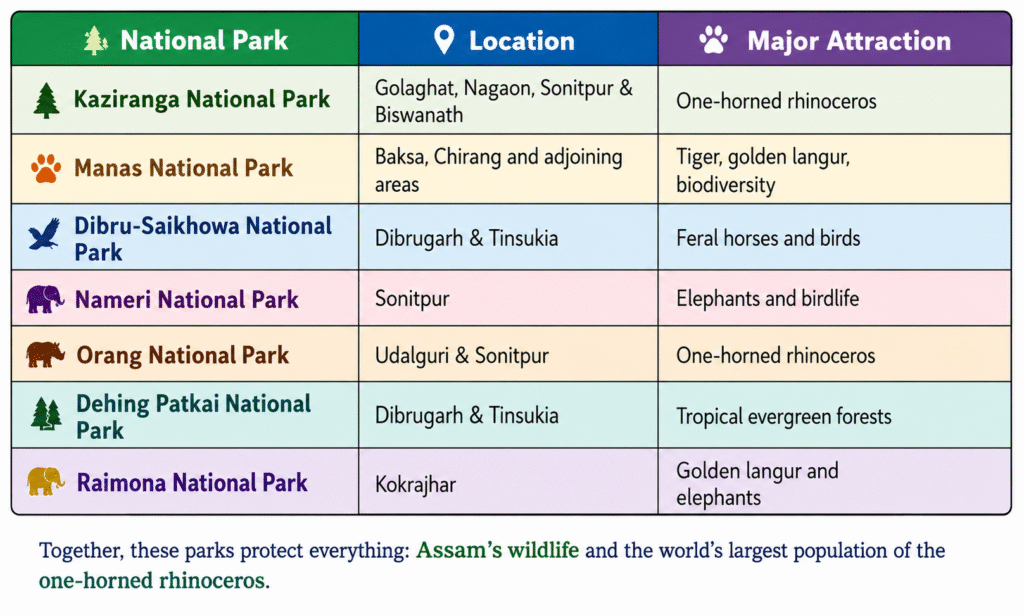
| National Park | Location | Major Attraction |
| Kaziranga National Park | Golaghat, Nagaon, Sonitpur & Biswanath | One-horned rhinoceros |
| Manas National Park | Baksa, Chirang and adjoining areas | Tiger, golden langur, biodiversity |
| Dibru-Saikhowa National Park | Dibrugarh & Tinsukia | Feral horses and birds |
| Nameri National Park | Sonitpur | Elephants and birdlife |
| Orang National Park | Udalguri & Sonitpur | One-horned rhinoceros |
| Dehing Patkai National Park | Dibrugarh & Tinsukia | Tropical evergreen forests |
| Raimona National Park | Kokrajhar | Golden langur and elephants |
.
Why Is Kaziranga National Park So Famous?
Kaziranga National Park is the most famous of the national parks of Assam and is internationally recognised for its successful conservation of the greater one-horned rhinoceros.

Located across parts of Golaghat, Nagaon, Sonitpur and Biswanath districts, Kaziranga represents the Brahmaputra Valley’s floodplain ecosystem. The Assam Forest Department describes it as an important habitat for rhinoceros, wild buffalo, swamp deer, elephant, tiger and other wildlife.
Major attractions
- One-horned rhinoceros
- Royal Bengal tiger
- Asian elephant
- Wild water buffalo
- Swamp deer
- Hog deer
- Migratory and resident birds
Kaziranga is also a UNESCO World Heritage Site and a tiger reserve, making it one of India’s most important protected areas.
Best time to visit: November to April.
Chronology of Kaziranga National Park
| Year/Period | Event | Significance |
| 1904 | Mary Curzon visited the Kaziranga area | She was concerned about the declining population of the one-horned rhinoceros and urged protection measures. |
| 1905 | Kaziranga Proposed Reserve Forest was created | This marked the beginning of formal conservation efforts in the region. |
| 1908 | Kaziranga was designated a Reserve Forest | Legal protection was strengthened. |
| 1916 | Kaziranga was declared a Game Sanctuary | Hunting was regulated and wildlife received greater protection. |
| 1938 | Hunting was prohibited | Kaziranga increasingly shifted from a hunting area toward wildlife conservation. |
| 1950 | Kaziranga was declared a Wildlife Sanctuary | The area received stronger conservation status after India’s independence. |
| 1954 | Assam Rhinoceros Bill was passed | It strengthened legal protection for the one-horned rhinoceros against poaching. |
| 1968 | Kaziranga National Park Act was passed | The park was given a stronger statutory framework for protection. |
| 1974 | Kaziranga was officially declared a National Park | It became one of India’s most important protected areas. |
| 1985 | Kaziranga was declared a UNESCO World Heritage Site | It gained international recognition for its exceptional biodiversity. |
| 2006 | Kaziranga was declared a Tiger Reserve | It became part of India’s Project Tiger network. |
| 2015 | Kaziranga received recognition as an important bird conservation area | Its importance for migratory and resident birds was highlighted. |
| 2022 | Assam government expanded Kaziranga’s protected landscape | Additional areas were incorporated to improve habitat and wildlife protection. |
| 2024 | Kaziranga celebrated 50 years as a National Park of Assam | The milestone highlighted five decades of wildlife conservation and management. |
| Present | Kaziranga remains a major conservation landscape | It is globally known for the greater one-horned rhinoceros, tigers, elephants, wild water buffalo, swamp deer and rich wetland biodiversity. |
Most Important Dates for APSC
1905 → Proposed Reserve Forest
1908 → Reserve Forest
1916 → Game Sanctuary
1950 → Wildlife Sanctuary
1974 → National Park
1985 → UNESCO World Heritage Site
2006 → Tiger Reserve
Easy memory chain:
Reserve → Game Sanctuary → Wildlife Sanctuary → National Park → World Heritage Site → Tiger Reserve
One important distinction: 1904 was the trigger for conservation efforts after Mary Curzon’s visit; 1905 marks the formal beginning of the protected-area process.
Beyond rhinos, Kaziranga is home to tigers (it has one of the highest densities of tigers among India’s reserves), wild water buffalo, elephants, and swamp deer. Jeep safaris through the central and western ranges are the most common way to see wildlife here, though elephant-back safaris still run in some zones during peak season.
What Makes Manas National Park Different from Kaziranga?
Located along the Himalayan foothills in western Assam, Manas National Park is another globally important protected area.

Manas has a remarkable conservation history. It was originally a game reserve, became a tiger reserve in 1974, a UNESCO World Heritage Site in 1985, a Biosphere Reserve in 1989, and a national park in 1990.
The park is known for its exceptional biodiversity and scenic landscapes.
Wildlife found in Manas
- Bengal tiger
- Asian elephant
- Golden langur
- Wild water buffalo
- One-horned rhinoceros
- Leopard
- Pygmy hog
- Hispid hare
- Several species of birds
Manas is particularly important for the conservation of endangered species and is recognised as an Important Bird Area. The Assam Forest Department records more than 500 bird species in the broader Manas ecosystem.
Best time to visit: November to April.
Manas has had a harder conservation history than Kaziranga, having lost and then rebuilt much of its wildlife population after periods of local unrest in the 1990s. Today it’s recognised as both a Tiger Reserve and a UNESCO World Heritage Site, and its recovery is often cited as one of the more remarkable conservation turnarounds in India.
Manas National Park — Important Chronology
| Year | Event |
| 1928 | Declared a Game Reserve |
| 1974 | Declared a Tiger Reserve under Project Tiger |
| 1985 | Declared a UNESCO World Heritage Site |
| 1989 | Declared a Biosphere Reserve |
| 1990 | Declared a National Park |
| 1992 | Listed as World Heritage Site in Danger |
| 2011 | Removed from the Danger List |
APSC Quick Recall:
1928 → Game Reserve → 1974 → Tiger Reserve → 1985 → UNESCO → 1989 → Biosphere → 1990 → National Park → 1992 → Danger → 2011 → Removed.
Is Nameri National Park Good for Birdwatching?
Yes — Nameri is arguably Assam’s best park for birdwatchers. Located in Sonitpur district near Tezpur, it records over 300 bird species, including the critically endangered white-winged wood duck, for which the park is a key stronghold. The Jia Bhoroli river running through Nameri also makes it one of the few parks in Assam where river rafting and angling for mahseer are part of the visitor experience, alongside walking trails — a rarity, since most Indian national parks restrict visitors to vehicles.
Situated in Sonitpur district, Nameri National Park lies close to the foothills of Arunachal Pradesh.
Forests, rivers and grasslands characterise the park and forms an important ecological landscape along the Assam-Arunachal Pradesh border.
Wildlife and attractions
Nameri is known for:
- Asian elephants
- Tigers
- Leopards
- Wild dogs
- Sambar
- Barking deer
- Hornbills
- Other forest and riverine birds
The Jia-Bhoroli River is an important attraction in the Nameri landscape, and the area is popular for nature-based tourism and river activities.
What’s Special About Dibru-Saikhowa, National Park?
Dibru-Saikhowa, in Tinsukia district in Assam’s far northeast, is a biodiversity hotspot built around wetlands, swamp forests, and grasslands where the Brahmaputra splits into the Dibru and Lohit channels. It’s best known for two things: a population of feral horses descended from animals abandoned during World War II-era tea estate operations, and another stronghold for the white-winged wood duck.
Located mainly in the Dibrugarh and Tinsukia region, Dibru-Saikhowa National Park is known for its distinctive wetland, grassland, and forest ecosystems.
It is also a Biosphere Reserve and an important habitat for a wide variety of birds and mammals. The park’s ecosystem was significantly shaped by the great earthquake of 1950.
Major attractions
- Feral horses
- Hoolock gibbon
- Gangetic dolphin
- Wild water buffalo
- Elephant
- Leopard
- Slow loris
- Migratory birds
Dibru-Saikhowa is particularly attractive to birdwatchers, with the Assam Forest Department recording more than 382 bird species in the park
The park’s wetlands also draw large numbers of migratory and resident water birds, making it a strong pick for visitors who want a quieter, less-touristed alternative to Kaziranga.
Why Do People Call Orang National Park “Mini Kaziranga”?
Orang earns the nickname “mini Kaziranga” because it shares the same floodplain grassland ecosystem and, crucially, has one of the highest densities of rhinos per square kilometre in India — even though the park itself is much smaller. Located across Darrang and Udalguri districts, Orang lets visitors experience a similar landscape and similar wildlife to Kaziranga, often with fewer crowds and shorter safari routes.
Orang National Park, located on the northern bank of the Brahmaputra, is sometimes called the “Mini Kaziranga” because of its similar floodplain ecosystem and population of one-horned rhinoceroses.
The park covers about 78.80 sq. km in the current Assam Forest Department description and supports rhinoceros, tiger, elephant, hog deer and other wildlife.
Major wildlife
- One-horned rhinoceros
- Bengal tiger
- Asian elephant
- Hog deer
- Wild pig
- Civet
- Gangetic dolphin
Orang is also an important bird habitat, with species such as the Bengal florican recorded in the area.
Best time to visit: November to April.
Dehing Patkai National Park
Located in Dibrugarh and Tinsukia districts, Dehing Patkai National Park is famous for its dense tropical evergreen forests.
It is particularly significant because it represents one of Assam’s remaining areas of Assam Valley Tropical Wet Evergreen Forests. The national park covers approximately 111.19 sq. km according to the Assam Forest Department.
Major attractions
- Hoolock gibbon
- Asian elephant
- Leopard
- Clouded leopard
- Slow loris
- Hornbills
- Numerous butterflies and reptiles
The surrounding landscape also has historical and cultural significance, with World War II cemeteries, the Stilwell Road and the historic Digboi oil region located nearby.
What Is Raimona National Park?
Raimona is Assam’s newest national park, officially declared in 2021 out of forest land in Kokrajhar district. It forms part of the larger Manas landscape and connects to forests across the border in Bhutan, effectively extending the transboundary habitat available to elephants, tigers, and golden langurs. Because it’s still a relatively young park in terms of tourism infrastructure, Raimona sees far fewer visitors than Assam’s older parks — which, depending on what you’re looking for, can be either a drawback or the exact appeal.
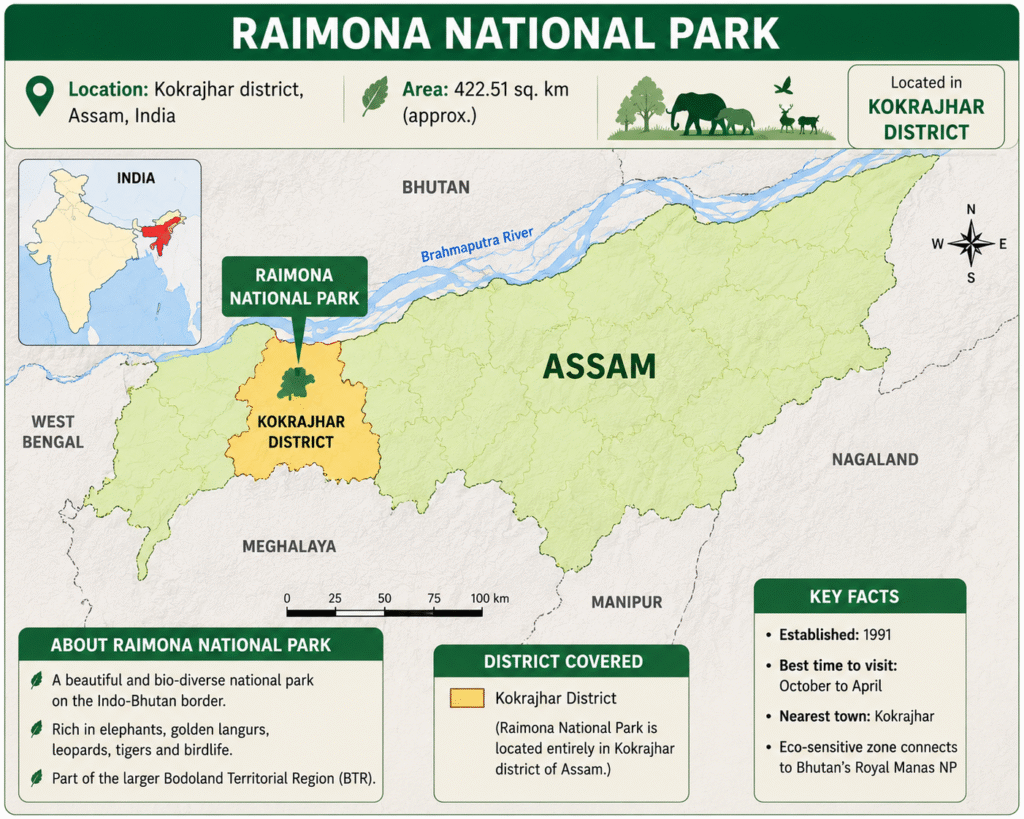
Raimona National Park is located in the Kokrajhar region of western Assam and is one of the newer national parks of the state.
The park is part of a larger transboundary landscape and is particularly important for the conservation of the golden langur, an iconic primate of the region.
Major wildlife
- Golden langur
- Asian elephant
- Leopard
- Bengal tiger
- Wild buffalo
- Various birds and reptiles
Raimona’s location makes it particularly significant for maintaining ecological connectivity between forests of Assam and neighbouring Bhutan.
Why Are the National Parks of Assam Important?
The national parks of Assam are not merely tourist destinations. They perform several crucial ecological and conservation functions.
1. Conservation of endangered species
Assam’s protected areas provide habitats for several threatened species, including the one-horned rhinoceros, Bengal tiger, golden langur, pygmy hog and hoolock gibbon.
2. Protection of biodiversity
Assam contains different ecosystems ranging from tropical evergreen forests and riverine forests to grasslands and wetlands. Its protected areas help conserve this ecological diversity.
3. Floodplain ecosystem conservation
Parks such as Kaziranga and Orang depend heavily on the natural dynamics of the Brahmaputra and its tributaries. Seasonal flooding helps maintain grasslands and wetlands that support herbivores and other wildlife.
4. Wildlife corridors
National parks and surrounding forests provide ecological connectivity for elephants, tigers and other animals. Maintaining these corridors is particularly important because roads, railways, settlements and other infrastructure can fragment habitats.
5. Tourism and local livelihoods
Wildlife tourism generates employment and supports local communities through accommodation, transport, guides, handicrafts and other tourism-related activities.
National Parks of Assam vs Wildlife Sanctuaries
National parks are only one component of Assam’s protected-area network. The state also has several wildlife sanctuaries, elephant reserves, tiger reserves and biosphere reserves.
According to the Assam Forest Department, the state’s protected-area network includes 7 national parks and 18 wildlife sanctuaries, covering about 4,938.53 sq. km.
Some important wildlife sanctuaries in Assam include:
- Pobitora Wildlife Sanctuary
- Hoollongapar Gibbon Wildlife Sanctuary
- Deepor Beel Wildlife Sanctuary
- Laokhowa-Burachapori Wildlife Sanctuary
- Chakrashila Wildlife Sanctuary
- Panidihing Wildlife Sanctuary
Therefore, while Kaziranga, Manas, Orang, Nameri, Dibru-Saikhowa, Dehing Patkai and Raimona are national parks, they form part of a much larger conservation landscape.
Best Time to Visit National Parks of Assam
The ideal season depends on the specific park, but November to April is generally considered a favourable period for visiting many of Assam’s national parks.
During this period:
- Weather is comparatively pleasant.
- Wildlife sightings are often better.
- Grasslands and wetlands are accessible.
- Safari activities are generally more convenient.
However, park opening dates, safari zones and tourism rules can change, so visitors should check the concerned park’s official information before planning a trip.
How Many National Parks Are There in Assam?
As of 2026, Assam has 7 national parks:
- Kaziranga National Park
- Manas National Park
- Dibru-Saikhowa National Park
- Nameri National Park
- Orang National Park
- Dehing Patkai National Park
- Raimona National Park
The Assam Forest Department’s current national-park listing confirms these seven parks.
Conclusion
The National Parks of Assam represent one of India’s most important wildlife conservation landscapes. From the rhino-rich floodplains of Kaziranga and the Himalayan foothills of Manas to the evergreen forests of Dehing Patkai and the golden-langur habitat of Raimona, each park contributes something unique to Assam’s ecological heritage.
Together, these seven national parks protect endangered wildlife, conserve diverse ecosystems and support tourism and local livelihoods. For travellers, they offer unforgettable wildlife experiences; for students preparing for APSC and UPSC, they are equally important topics in environment, geography and Assam-specific general knowledge.
Source – National parks of | Assam State Portal
Also read – Chief Ministers of Assam Since Independence
FAQs on National Parks of Assam
How many are the national parks of Assam?
There are seven national parks of Assam.
Which is the most famous among the national parks of Assam?
Kaziranga National Park is the most famous among the national parks of Assam, particularly for its population of the one-horned rhinoceros and its rich biodiversity.
Which national parks of Assam are UNESCO World Heritage Sites?
Kaziranga and Manas are among the national parks of Assam that have UNESCO World Heritage recognition. Kaziranga is known for its one-horned rhinoceros, while Manas is renowned for its diverse wildlife and landscape.
Which national parks of Assam are known for rare wildlife?
Several of the national parks of Assam protect rare and endangered species. Kaziranga is famous for the one-horned rhinoceros, Manas for the pygmy hog and golden langur, and Dibru-Saikhowa for its unique wetland and bird diversity.
Why are the national parks of Assam important for conservation?
The national parks of Assam play a vital role in conserving endangered species, protecting forests and wetlands, preserving biodiversity, and supporting wildlife research and eco-tourism in the state.