

The Assam High Court, officially known as the Gauhati High Court, is one of the oldest constitutional courts in Northeast India. It plays an important role in protecting constitutional rights, interpreting laws, and ensuring access to justice for the people of Assam and other northeastern states. Established soon after India’s independence, the court has witnessed major political, social, and administrative transformations in the region.
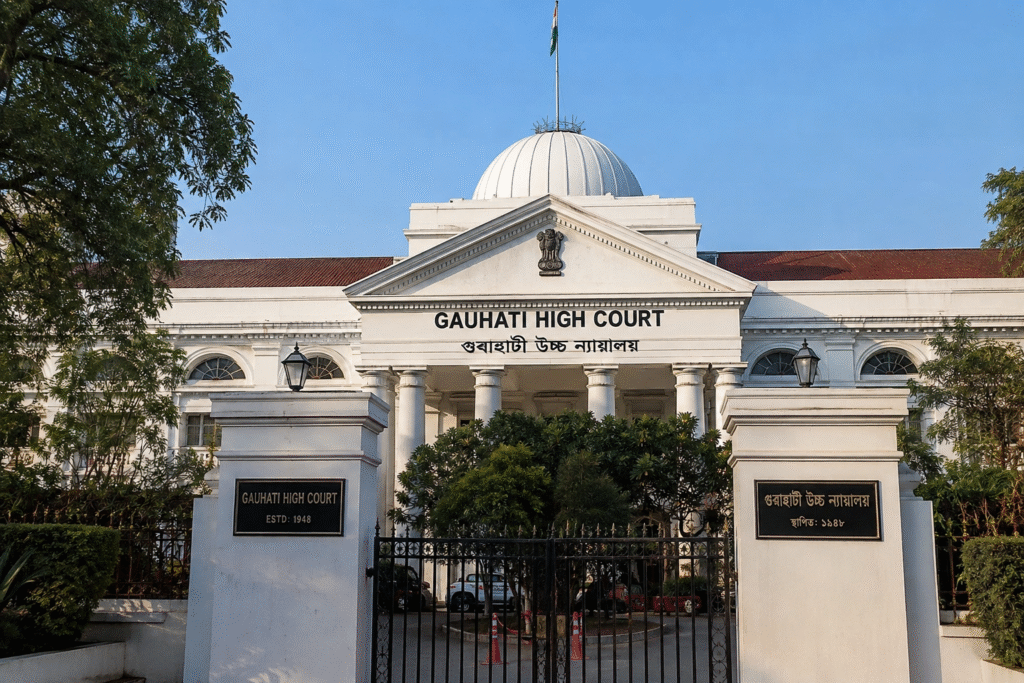
For students preparing for APSC, ADRE, Assam government exams, and other competitive examinations, understanding the history and jurisdiction of Assam High Court is important from both polity and regional history perspectives.
Assam High Court: Overview
| Aspect | Details |
| Official Name | Gauhati High Court |
| Established | 1948 |
| Original Jurisdiction | Assam and other northeastern regions |
| Location | Guwahati, Assam |
| Chief Justice | Appointed by the President of India |
| Jurisdiction Today | Assam, Nagaland, Mizoram and Arunachal Pradesh |
| Type | Constitutional High Court |
| Article of the Constitution | Articles 214–231 |
| Principal Seat | Guwahati |
| Main Functions | Appeals, writ petitions, judicial review, constitutional matters and supervision of subordinate courts |
| Historical Importance | It was the first High Court established in Northeast India |
| Current Name | Gauhati High Court, commonly referred to as Assam High Court |
History of Assam High Court
Establishment of Assam High Court (1948)
The origin of the present-day Gauhati High Court can be traced back to the High Court of Assam, which was established on 5 April 1948 under the Assam High Court Order, 1948. The decision to establish a separate High Court for Assam was preceded by a resolution adopted by the Assam Legislative Assembly on 9 September 1947.
The establishment was made possible through the powers provided under Section 229(1) of the Government of India Act, 1935, as adapted by the Indian Provincial Constitution (Amendment) Order, 1948.
The first Chief Justice of the Assam High Court was Sir R.F. Lodge, who took the oath on 5 April 1948. The inauguration ceremony was attended by Sir Harilal Kania, the then Chief Justice of India, Governor Sir Akbar Hydari, and the then CM Gopinath Bordoloi.
Today known as the Gauhati High Court, its journey reflects the evolving legal and constitutional landscape of Northeast India — a story shaped by territorial changes, administrative transformations, and the region’s pursuit of accessible justice over the decades.
Why Was the Assam High Court Established?
The idea of having a separate high court for Assam came from Assam itself, not from Delhi. After independence, the Assam Legislative Assembly felt that the state needed its own higher court so that people would no longer have to depend on the Calcutta High Court for important legal matters.
On 9 September 1947, the Assam Legislative Assembly passed a resolution requesting the creation of a separate high court. Based on this request, the Governor-General issued the Assam High Court Order, 1948 on 1 March 1948, officially establishing the High Court of Assam from 5 April 1948.
The court initially started functioning in Shillong, which was the capital of undivided Assam at that time. A few months later, on 14 August 1948, it was shifted to Gauhati (now Guwahati). This move helped make Guwahati the main centre of legal and judicial activities in Northeast India.
Where Was The Early Location of the Assam High Court?
Initially, the Assam High Court functioned from Shillong, which was the capital of Assam at that time. However, due to administrative reasons, the court was shifted to Gauhati (now Guwahati) on 14 August 1948.
With the shifting of the court to Guwahati, the city gradually developed into the judicial centre of Northeast India.
Evolution into Gauhati High Court
Assam and Nagaland High Court
After the creation of the state of Nagaland in 1963, the Assam High Court was renamed the High Court of Assam and Nagaland with effect from 1 December 1963.
Formation of Gauhati High Court (1971)
The North-Eastern Areas (Reorganisation) Act, 1971 brought major changes to the judicial structure of Northeast India. A common High Court was created for several northeastern states and union territories, and it was named the Gauhati High Court.
At that time, the jurisdiction of the Gauhati High Court extended over:
- Assam
- Nagaland
- Meghalaya
- Manipur
- Tripura
- Mizoram
- Arunachal Pradesh
Thus, for several decades, the Gauhati High Court served as the common High Court for almost the entire Northeast region.
Creation of Separate High Courts in Northeast India
The judicial structure of Northeast India changed after the creation of separate High Courts for:
- Meghalaya
- Manipur
- Tripura
in 2013.
After this reorganisation, the jurisdiction of Gauhati High Court was limited primarily to:
- Assam
- Nagaland
- Mizoram
- Arunachal Pradesh
Today, the Gauhati High Court remains one of the most significant judicial institutions of Northeast India.
How Is the Court Structured Today?
The Gauhati High Court is located on Mahatma Gandhi Road in Guwahati. Over the years, its strength has increased significantly from the time it started with only one Chief Justice. Today, the court has several judges who handle a wide range of cases from across the region.
Judges of the High Court are appointed by the President of India after consultation with the Chief Justice of India and the Governor of the concerned state. Like other High Court judges in India, they can serve until the age of 62 years. If anyone is not satisfied with a High Court judgment, an appeal can be made before the Supreme Court of India.
What Is the Territorial Jurisdiction of the Assam High Court Today?
The jurisdiction of the Gauhati High Court can be understood under different categories:
1. Territorial Jurisdiction
To serve people across the vast and geographically challenging Northeast, the Gauhati High Court does not function only from Guwahati. Instead, it works through its main seat in Guwahati along with permanent benches in different states.
The Kohima Bench, established in December 1972, serves the people of Nagaland. The Aizawl Bench, opened in July 1990, serves Mizoram, while the Itanagar Bench, inaugurated in August 2000 at Naharlagun near Itanagar, serves Arunachal Pradesh.
This system makes justice more accessible for people living in distant and hilly regions, as they do not have to travel all the way to Guwahati for every legal matter. At the same time, major constitutional and administrative issues continue to be handled in coordination with the principal seat of the High Court.
The Gauhati High Court currently exercises jurisdiction over:
- Assam
- Nagaland
- Mizoram
- Arunachal Pradesh
2. Original Jurisdiction
The High Court has limited original jurisdiction, meaning certain cases can be directly filed before it.
Examples include:
- Matters related to fundamental rights through writ petitions
- Election petitions
- Certain cases assigned under specific laws
3. Appellate Jurisdiction
The Gauhati High Court acts as an appellate court over subordinate courts within its territorial jurisdiction.
It hears appeals related to:
Civil Cases
- Property disputes
- Contract disputes
- Family matters
- Other civil issues
Criminal Cases
- Appeals against judgments of lower courts
- Bail applications
- Criminal revisions
4. Writ Jurisdiction
Under Article 226 of the Constitution of India, High Courts have the power to issue writs for enforcement of fundamental rights and other legal rights.
The five major writs issued by the High Court are:
Habeas Corpus
To protect personal liberty against unlawful detention.
Mandamus
To order a public authority to perform its legal duty.
Prohibition
To prevent a lower court from exceeding its jurisdiction.
Certiorari
To transfer or cancel orders of lower courts or tribunals.
Quo Warranto
To question the legality of a person’s appointment to a public office.
5. Supervisory Jurisdiction
Under Article 227 of the Constitution, the High Court supervises all subordinate courts and tribunals within its territorial jurisdiction.
This power ensures:
- Proper functioning of lower courts
- Correct interpretation of law
- Judicial discipline
Constitutional Position of Assam High Court
Like all High Courts in India, the Gauhati High Court derives its authority from the Constitution of India.
Important constitutional provisions related to High Courts include:
| Article | Provision |
| Article 214 | High Courts for States |
| Article 215 | High Courts as Courts of Record |
| Article 216 | Constitution of High Courts |
| Article 217 | Appointment and conditions of judges |
| Article 226 | Power to issue writs |
| Article 227 | Superintendence over subordinate courts |
Why Doesn’t It Cover the Whole Northeast Anymore?
When the Northeastern states began gaining full statehood, the judicial structure also changed. Manipur, Meghalaya, and Tripura became full-fledged states during the 1970s and 1980s and later established their own separate high courts. As a result, the Gauhati High Court no longer had jurisdiction over these states.
Mizoram and Arunachal Pradesh also became full states in 1986. However, instead of creating separate high courts, they continued under the jurisdiction of the Gauhati High Court along with Assam and Nagaland.
This is why the court’s official name remains the “High Court of Assam, Nagaland, Mizoram and Arunachal Pradesh.” The name reflects the states that continue to come under its jurisdiction, while also preserving the history of the larger role the court once played across the entire Northeast.
Importance of Assam High Court
The Gauhati High Court has played a significant role in shaping the legal and constitutional landscape of Northeast India.
Its importance includes:
1. Protection of Constitutional Rights
The court safeguards fundamental rights and provides judicial remedies to citizens.
2. Maintaining Rule of Law
It ensures that government authorities function according to constitutional principles.
3. Addressing Regional Issues
The court has dealt with issues involving:
- Land rights
- Tribal rights
- Environmental protection
- Citizenship matters
- Administrative disputes
4. Strengthening Justice Delivery in Northeast India
Being the oldest High Court in the region, it has contributed significantly to developing legal institutions in northeastern states.
Conclusion
The Assam High Court, now known as the Gauhati High Court, represents an important chapter in India’s judicial history. Established in 1948, it evolved from a provincial High Court of Assam into a major judicial institution serving the northeastern region. Through its constitutional powers, appellate authority, and role in protecting citizens’ rights, the Gauhati High Court continues to remain a pillar of justice in Assam and Northeast India
Also read – Chief Ministers of Assam