

Every year, lakhs of aspirants across India sit at their desks, textbooks stacked high, dreaming of a career in civil services. The fantasy is vivid — walking into a Collectorate, representing the government at national forums, making policy that touches millions of lives. But the journey begins with a question that is IAS vs ACS that often trips up even the most well-prepared candidates:
“What is the difference between IAS and ACS — and which one should I target?”
If you have been scratching your head over this, you are in the right place. This comprehensive guide breaks down the IAS vs ACS debate in full detail — covering definitions, recruitment processes, job profiles, salary structures, promotion trajectories, and the lifestyle realities of both services. By the time you finish reading, you will have a crystal-clear picture of where your civil services journey should take you.
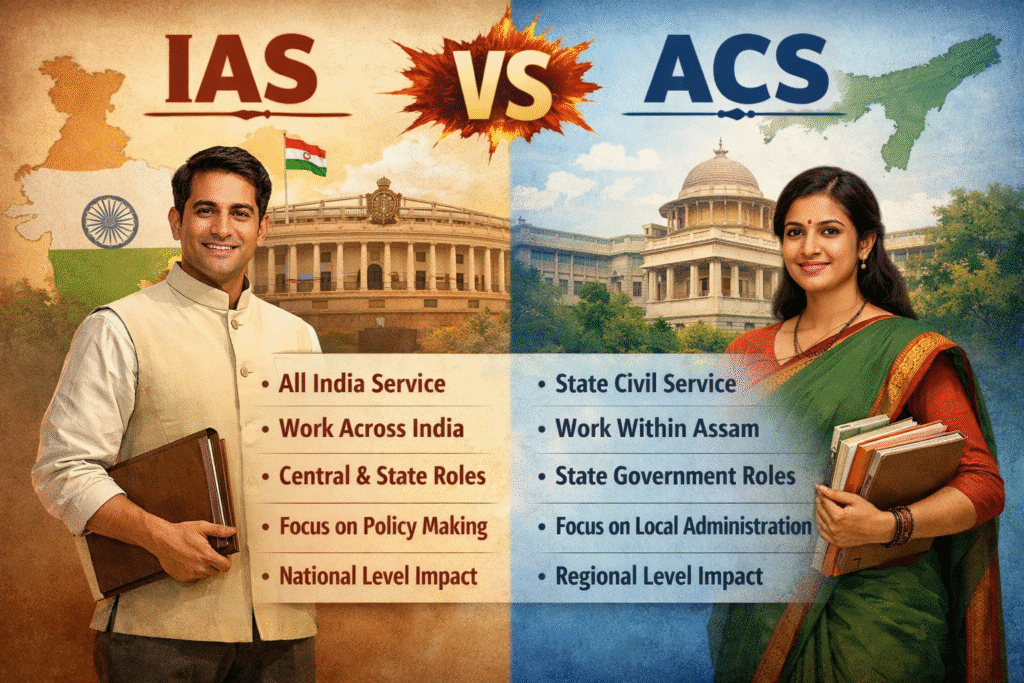
What is the IAS? A Primer on India’s Most Coveted Service
The Indian Administrative Service, universally known as the IAS, sits at the very apex of India’s bureaucratic pyramid. It is one of the three All-India Services (along with IPS and IFoS) and is directly controlled by the Ministry of Personnel, Public Grievances and Pensions under the Government of India.
The IAS traces its lineage to the colonial-era Indian Civil Service (ICS) and was formally constituted after independence in 1947 under Article 312 of the Indian Constitution. Officers recruited to the IAS serve both at the state and central government levels, making it a truly national service with a pan-India character.
Core Characteristics of the IAS
- Recruited through the UPSC Civil Services Examination — one of the most competitive exams in the world
- Officers are allotted to specific state cadres but can be deputed to the Central Government
- IAS officers occupy the most senior administrative positions across all levels of governance
- The service is governed by the All India Services Act, 1951
- Officers enjoy constitutional protection and cannot be removed except through a special process
The IAS is not just a job — it is a constitutional mandate. IAS officers form the steel frame of Indian democracy, ensuring the continuity of governance regardless of political changes.
What is the ACS? Understanding Allied and State Civil Services
The term ACS refers to the Allied Civil Services or, in certain state-specific contexts, the State Civil Service. Depending on the context, ACS can mean two distinct things:
1. Allied Services (Central Government Context)
At the central level, Allied Services are those recruited alongside the IAS, IPS, and IFoS through the UPSC Civil Services Exam. These include services such as the Indian Revenue Service (IRS), Indian Foreign Service (IFS), Indian Audit and Accounts Service (IAAS), Indian Postal Service (IPoS), and many more. Candidates who clear the UPSC exam but do not make the cut for the top three services are allocated to these allied services based on merit and preference.
2. State Civil Services (State PSC Context)
At the state level, ACS often refers to the State Civil Service or the entry-level administrative service recruited by the respective State Public Service Commission (PSC). For example, Andhra Pradesh has the APCS (Andhra Pradesh Civil Service), Maharashtra has the MCS (Maharashtra Civil Service), and so on. These are sometimes collectively and informally referred to as ACS or Allied Civil Services in public discourse.
For the purpose of this blog, we will primarily compare IAS with State Civil Services (also called ACS or Provincial Civil Services), as this is the comparison most aspirants seek.
IAS vs ACS: Quick Comparison at a Glance
The table below provides a bird’s-eye view of the key differences between IAS and ACS (State Civil Services):
| IAS (Indian Administrative Service) | ACS (Allied / State Civil Services) |
| Recruited by UPSC Civil Services Exam | Recruited by State PSC (e.g., APSC) |
| All-India Service under Central Government | State Service under respective State Government |
| Cadre allotment across states (national posting) | Posting limited to the recruiting state only |
| Can serve both at Centre and State level | Primarily serves at state/district level |
| Handles top administrative roles (DM, Collector, Secretary) | Fills Deputy Collector, SDM, Block Development Officer roles |
| Eligible for deputation to Central Ministries, PSUs, UN bodies | Limited scope for central deputation |
| Exam: UPSC CSE (Prelims + Mains + Interview) | Exam: State PSC (varies by state) |
| Age limit: 21–32 years (relaxation for reserved categories) | Age limit: 21–35 years (varies by state) |
| Pay Scale: Level 10 to Level 17 (7th CPC) | Pay Scale: State-specific; generally lower than IAS |
Recruitment Process: How Do You Get Into IAS vs ACS?
Getting Into the IAS: The UPSC Civil Services Exam
The path to the IAS runs exclusively through the UPSC Civil Services Examination — widely regarded as the hardest competitive examination in India. The exam is conducted in three stages:
- Preliminary Examination (Prelims): Two objective papers — General Studies Paper I and CSAT (Civil Services Aptitude Test). Acts as a screening test.
- Main Examination (Mains): Nine descriptive papers including Essay, four GS papers, two optional subject papers, and two qualifying language papers.
- Personality Test (Interview): A 275-mark interview conducted by the UPSC board to assess personality, leadership potential, and administrative aptitude.
The final merit list is drawn on the basis of Mains + Interview marks. Only the top-ranked candidates who clear all three stages and feature in the final merit list within the IAS cutoff are allocated to the IAS. In 2023, for example, the IAS cutoff for the general category was around Rank 90 out of approximately 1,016 total selections — a staggeringly competitive threshold.
Getting Into ACS: The State PSC Exam
Each state has its own Public Service Commission that conducts recruitment to the State Civil Services. The format is broadly similar to UPSC — Preliminary, Mains, and Interview — but the syllabus, difficulty level, language of examination, and specific eligibility criteria vary significantly from state to state.
- Maharashtra: MPSC (Maharashtra Public Service Commission) — MPSC State Services Examination
- Uttar Pradesh: UPPSC (Uttar Pradesh PSC) — PCS Examination
- Andhra Pradesh: APPSC — Group 1 Services Examination
- Tamil Nadu: TNPSC — Group 1 Services Examination
- Karnataka: KPSC — KAS Examination
While the State PSC exams are comparatively less difficult than UPSC CSE, they are fiercely competitive in their own right. In populous states like UP, Bihar, and Maharashtra, thousands of candidates compete for a handful of seats. Success requires dedicated preparation spanning one to two years.
Key Insight: Candidates who attempt UPSC CSE but do not secure IAS can still serve as District Magistrates or senior administrators if they clear their state’s PSC exam. Many successful bureaucrats have made this transition.
Job Profile and Powers: What Do IAS and ACS Officers Actually Do?
The Role of an IAS Officer
An IAS officer’s career is one of extraordinary variety. At the district level, an IAS officer typically serves as the District Magistrate (DM) or District Collector — the single most powerful administrative figure in a district. This role combines executive, judicial, and revenue functions. The DM oversees law and order, disaster management, public grievance redressal, and implementation of central and state schemes.
As they move up the career ladder, IAS officers take on roles such as:
- Commissioner or Divisional Commissioner — overseeing multiple districts
- Secretary or Principal Secretary to the State Government — heading departments like Finance, Home, Health, or Education
- Chief Secretary — the topmost bureaucratic position in a state
- Joint Secretary or Additional Secretary at the Central Government — influencing national policy
- Secretary to the Government of India — the most senior IAS role at the Centre
Beyond domestic roles, IAS officers are regularly deputed to international organisations such as the United Nations, World Bank, IMF, and ADB, as well as central government undertakings and regulatory bodies.
The Role of an ACS / State Civil Service Officer
State Civil Service officers also perform critical administrative functions, particularly at the grassroots and sub-divisional levels. A newly recruited ACS officer typically joins as a Deputy Collector or Sub-Divisional Magistrate (SDM). Their responsibilities include:
- Revenue administration and land record management
- Implementation of state and central government welfare schemes
- Maintenance of law and order at the sub-district level
- Supervision of development projects in rural and semi-urban areas
- Functioning as Returning Officers during elections
ACS officers with exceptional performance records can be promoted to senior positions such as Additional Collector, Joint Collector, and even Collector over a long career. However, their scope remains largely within the state and rarely extends to central assignments.
Salary, Perks & Benefits: IAS vs ACS — Who Earns More?
IAS Salary Structure (7th Pay Commission)
IAS officers are paid under the Central Pay Scales recommended by the 7th Pay Commission. The pay progression across career stages is:
- Junior Time Scale (Entry level): Pay Level 10 — Basic pay of Rs. 56,100 per month
- Senior Time Scale: Pay Level 11 — Basic pay of Rs. 67,700 per month
- Junior Administrative Grade: Pay Level 12 — Basic pay of Rs. 78,800 per month
- Selection Grade / Super Time Scale: Pay Level 14–15 — Basic pay of Rs. 1,44,200 to Rs. 1,82,200 per month
- Apex Scale (Chief Secretary equivalent): Pay Level 17 — Basic pay of Rs. 2,25,000 per month
Beyond basic pay, IAS officers receive a comprehensive bouquet of allowances and perquisites: House Rent Allowance (HRA), Dearness Allowance (DA), Travel Allowance (TA), government accommodation (bungalows in many postings), official vehicle with driver, domestic staff, free or subsidised medical care, and prestigious club memberships. The combined value of these perks often exceeds the basic pay itself.
ACS / State Civil Service Salary Structure
ACS officers are paid according to the respective state government’s pay matrix, which is typically lower than central pay scales. State governments revise their pay structures periodically following the recommendations of State Pay Commissions. In most states:
- Entry-level pay ranges from Rs. 45,000 to Rs. 65,000 per month (basic), depending on the state
- Mid-level senior officers earn between Rs. 75,000 and Rs. 1,25,000 per month
- The highest-ranking ACS officers may receive Rs. 1,40,000 to Rs. 1,75,000 per month
Allowances and perks exist for ACS officers as well — government housing, vehicle, medical benefits — but they are generally less lavish than those extended to IAS officers. The prestige quotient, too, tends to be slightly lower than IAS, though ACS officers command enormous respect in their home states.
Promotion & Career Growth: Who Climbs Faster?
IAS Career Progression
IAS career growth follows a defined timeline anchored to years of service. The Department of Personnel and Training (DoPT) has established clear promotion norms:
- 1–4 years of service: Probationer / Junior Time Scale
- 5 years: Senior Time Scale
- 9 years: Junior Administrative Grade
- 13 years: Non-Functional Selection Grade (NFSG)
- 14 years: Senior Administrative Grade (SAG)
- 17 years and above: Higher Administrative Grade (HAG) — Joint Secretary equivalent
- 25+ years: Apex Scale and Cabinet Secretary/Chief Secretary level
The IAS also has a unique concept of ‘non-functional upgradation’ where officers receive pay benefits of the next grade even when substantive posts are not available. This ensures financial progression even when administrative promotions are delayed.
ACS Career Progression
State Civil Service officers face a different and often slower career trajectory. The number of senior posts is limited, and promotions depend heavily on state-specific DPC (Departmental Promotion Committee) norms. In many states, ACS officers plateau at the level of Additional Collector or Joint Collector and may wait decades for higher positions.
However, an important bridge exists between the two services: State Civil Service officers can be promoted to the IAS through a mechanism known as the SCS Promotion Quota. Each year, a certain number of SCS officers who have completed 8 years of service and are under 54 years of age are considered for promotion to the IAS through a screening process. This provides a second shot at the IAS for exceptional state service officers.
SCS Promotion Quota: Typically, 33% of IAS cadre strength is filled by State Civil Service officers promoted to the IAS. This is a significant pathway that many ACS officers aspire to.
Prestige, Lifestyle & Work-Life Balance: The Reality on the Ground
The Prestige Factor
There is no sidestepping the prestige gradient. In public perception and institutional hierarchy, the IAS enjoys a unique aura that no other civil service in India quite matches. An IAS District Collector wields power that state-level counterparts do not — from officiating at national events to liaising directly with the PMO and cabinet ministers. IAS officers are routinely featured in national media, and their decisions reverberate at the national level.
ACS officers are highly respected within their states and districts. A Deputy Collector or an SDM is an immensely powerful figure in rural India — citizens approach them with deference, political leaders seek their cooperation, and community issues land squarely on their desks. While the national spotlight may not shine on ACS officers, the local impact is profound and immediate.
Work-Life Balance & Transfers
Both IAS and ACS officers must be prepared for demanding work schedules, especially during election seasons, natural disasters, and policy rollouts. Transfers are a way of life — IAS officers can be transferred across districts, divisions, states, and even to New Delhi. This means uprooting families and adjusting to new environments frequently.
ACS officers are generally posted within their home state, which can mean less disruption to family life. Many aspirants from a particular state specifically target ACS over IAS precisely for this reason — the ability to serve close to home while still holding an impactful administrative position.
The Urban-Rural Divide
IAS postings can range from plum metro assignments (secretary-level posts in Delhi, state capitals) to remote district headquarters in challenging terrain. Tribal districts, border regions, and disaster-prone areas often have IAS DMs who are posted under challenging circumstances. For those who relish adventure and field work, these postings are career-defining. For those with family commitments, they can be taxing.
ACS officers also face postings in remote areas, particularly in large states. The experience, however, is similar — a chance to make a direct difference in people’s lives while grappling with limited infrastructure and resources.
IAS or ACS: Which One Should You Target?
The answer depends on your goals, risk appetite, and circumstances. Here is a framework to help you decide:
Choose IAS if…
- You want a national and international career trajectory
- You are willing to invest 2–4 years in intensive UPSC preparation
- You aspire to influence national-level policy and governance
- You are comfortable with frequent transfers and life in diverse regions of India
- You seek the highest level of prestige, authority, and perks
Choose ACS if…
- You want to serve in your home state and prefer regional stability
- You want to start your administrative career sooner through State PSC
- You are equally passionate about grassroots governance and district-level administration
- You are working or have personal obligations that limit full-time UPSC prep
- You plan to pursue IAS promotion through the SCS quota after gaining experience
Pro Tip: Many aspirants appear for both UPSC CSE and their State PSC simultaneously. Clearing the State PSC first gives you financial stability and practical administrative experience while you continue pursuing IAS.
Common Myths About IAS and ACS — Busted!
Myth 1: ACS officers have no real power
False. A Deputy Collector in UP or Maharashtra handles crores of rupees in welfare schemes, presides over revenue courts, and holds quasi-judicial powers. The power is substantial — it is simply more localised than an IAS officer’s mandate.
Myth 2: You can only become IAS through UPSC
Partially true. While fresh recruitment to IAS happens only via UPSC CSE, experienced State Civil Service officers can be promoted to IAS through the SCS Promotion Quota, bypassing the UPSC exam entirely.
Myth 3: ACS preparation is very different from IAS preparation
Not entirely. The syllabus overlap is significant. Many candidates prepare for both exams using a shared study plan, making minor adjustments for state-specific topics required by State PSCs.
Myth 4: IAS is always better than ACS
Not necessarily. For someone deeply rooted in their state, with family, language, and community connections, an ACS career can be more fulfilling, sustainable, and impactful than an IAS posting to an unfamiliar state or remote district.
Conclusion: Both Are Noble Paths — Choose with Purpose
The IAS vs ACS debate does not have a universally correct answer. Both services represent the best of India’s administrative machinery. Both demand intelligence, integrity, and a genuine commitment to public service. Both give you the rare privilege of wielding real power in service of real people.
If you can dedicate yourself fully to cracking UPSC CSE, the IAS offers unmatched scope, prestige, and career variety. If you want to make an immediate, visible difference in your home state while building a rock-solid administrative career, ACS is a worthy and fulfilling choice.
Whatever you choose, remember: the measure of a civil servant is not the prefix before their name. It is the quality of governance they deliver and the lives they change. Prepare diligently, serve sincerely, and the service will reward you.
“In service lies the true privilege of authority.” — Start your preparation today.
Also Read
| S.No | Blog Title | Link |
|---|---|---|
| 1 | APSC Mains GS II Syllabus | Read Blog |
| 2 | APSC Mains GS III Syllabus | Read Blog |
| 3 | APSC Mains GS IV Syllabus | Read Blog |
| 4 | APSC Mains GS Paper V Syllabus | Read Blog |
| 5 | APSC Ethics Paper & Case Studies | Read Blog |
| 6 | APSC Toppers Writing Techniques | Read Blog |
FAQs on IAS vs ACS
What is the main difference between IAS vs ACS?
The key difference in IAS vs ACS lies in their scope and authority. IAS officers are part of an All-India Service recruited through UPSC and can serve at both central and state levels, whereas ACS officers are recruited through State PSCs and primarily serve within their respective states.
Which is better: IAS vs ACS?
The answer to IAS vs ACS depends on your career goals. IAS is better for those seeking national-level exposure, higher authority, and policy-making roles, while ACS is ideal for candidates who want stability and to work within their home state.
Can an ACS officer become an IAS officer?
Yes, in the IAS vs ACS pathway, ACS (State Civil Service) officers can be promoted to IAS through the SCS Promotion Quota after meeting eligibility criteria like years of service and performance.
Who has more power: IAS vs ACS?
In the comparison of IAS vs ACS, IAS officers generally hold more authority, especially at senior levels like District Collector or Secretary. However, ACS officers also have substantial power at the district and sub-divisional levels.
What is the salary difference in IAS vs ACS?
In IAS vs ACS, IAS officers typically receive higher salaries under the 7th Pay Commission along with better perks. ACS salaries vary by state and are usually slightly lower, though still highly respectable.
Can I prepare for IAS and ACS together?
Yes, many aspirants prepare for both. In the IAS vs ACS preparation strategy, there is significant syllabus overlap, especially in General Studies, making it efficient to target both exams simultaneously.
Which has better work-life balance: IAS vs ACS?
When comparing IAS vs ACS, ACS officers often have relatively better work-life balance due to postings within the home state, while IAS officers face frequent transfers and broader responsibilities.
Is ACS less prestigious than IAS?
In the IAS vs ACS debate, IAS holds higher national prestige, but ACS officers are highly respected within their states and play crucial roles in governance at the grassroots level.
How long does it take to clear IAS vs ACS?
For IAS vs ACS, UPSC preparation may take 2–4 years due to its difficulty level, while ACS exams may take relatively less time depending on the state and competition.
Do IAS and ACS officers have similar job roles?
In IAS vs ACS, both officers work in administration, law and order, and policy implementation. However, IAS officers operate at a broader level, while ACS officers focus more on district and state-level governance.