

A structured, no-fluff roadmap for serious aspirants who want to cover the entire UPSC Civil Services syllabus — Prelims and Mains — in twelve focused months. In this article, we will discuss how to cover the UPSC syllabus in one year, including a month-by-month breakdown, subject-wise strategy, daily study hours, revision techniques, and expert tips to make your one-year UPSC preparation count.
Cracking the UPSC Civil Services Examination (CSE) is widely regarded as one of India’s toughest academic challenges. With a syllabus spanning history, geography, polity, economy, science, current affairs, ethics, and optional subjects — many aspirants feel overwhelmed before they even begin.
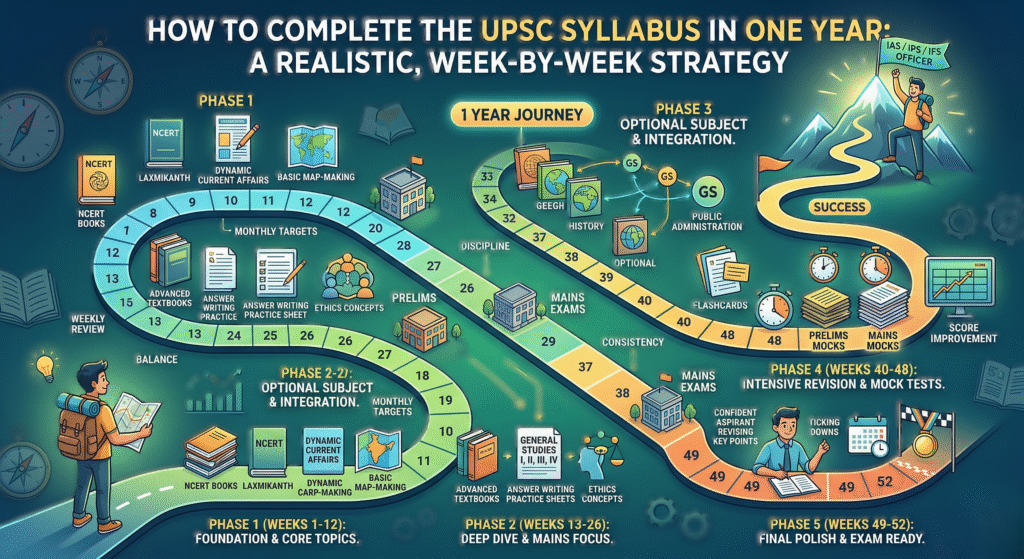
The good news: one year is sufficient to cover the entire UPSC syllabus — provided you plan smartly, stay consistent, and revise relentlessly.
| 365 Days to cover the syllabus | 8-10 Hours of daily study | 2+ Full revisions before Prelims |
Why UPSC Syllabus in One Year Is the Sweet Spot
Most successful IAS officers report preparing for 12 to 18 months. One year is optimal because it is long enough to cover everything with depth, yet short enough to maintain intensity and momentum. Studies spanning 2-3 years without structure often lead to burnout, outdated notes, and declining motivation.
| KEY | UPSC does not reward the person who studied the most. It rewards the person who revised the most and applied knowledge most intelligently. Your one-year plan must build in at least 3 revision cycles. |
Understanding the UPSC Syllabus Structure
Before planning your UPSC syllabus in one year, you must understand what you are preparing for. The UPSC CSE has three stages, with the following components:
| Component | Details | Marks / Nature |
| Prelims – GS Paper I | 100 MCQs | 200 marks |
| Prelims – CSAT | Aptitude Paper | Qualifying (33%) |
| Mains – 9 Papers | GS I-IV + Essay + Optional | Written exam |
| Optional Subject | Paper I and Paper II | 500 marks |
| Essay Paper | 2 essays | 250 marks |
| Personality Test | Interview | 275 marks |
Month-by-Month UPSC syllabus in One Year
Divide the year into four phases — Foundation, Advanced Coverage, Integration and Mock Tests, and Revision Sprint.
| Period | Phase | Focus Areas |
| Month 1-2 | Foundation | Read NCERT books (Class 6-12) for History, Geography, Polity, Economy, and Science. Build conceptual base before advanced sources. Begin newspaper reading daily. |
| Month 3-5 | Advanced Coverage | Move to standard references: Laxmikanth (Polity), Bipan Chandra (Modern History), Spectrum, Ramesh Singh (Economy). Begin optional subject. Make concise notes. |
| Month 6-8 | GS Mains + Current Affairs | Cover GS Mains topics: Environment, Internal Security, Ethics (GS IV), Social Issues. Compile 6-8 months of current affairs. Begin answer writing practice daily. |
| Month 9-10 | Prelims Intensive | Shift 60% time to Prelims. Attempt 2,000+ MCQs. Revise all static subjects twice. Practice CSAT weekly. Identify and plug weak areas aggressively. |
| Month 11 | Post-Prelims Mains Push | Immediately shift to Mains answer writing. Complete full-length tests for all GS papers. Revise optional. Write 5-6 full essays and get them evaluated. |
| Month 12 | Final Revision Sprint | Final revision of all notes. Revise 12 months of current affairs. No new books. Focus on weak areas, PYQ analysis, and mental composure. |
Subject-Wise Priority and Time Allocation
Not all subjects carry equal weight in Prelims and Mains. Here is a realistic weekly time allocation for an aspirant studying 8-10 hours a day:
| Subject | Weekly Hours | Note |
| History + Culture | 8-10 hrs/week | Focus in Phase 1-2 |
| Polity | 8-10 hrs/week | High ROI for Prelims + Mains |
| Geography | 6-8 hrs/week | Practice maps daily |
| Economy | 6-8 hrs/week | Link to current affairs |
| Environment | 4-5 hrs/week | High Prelims weightage |
| Science & Technology | 3-4 hrs/week | Current-affairs focused |
| Ethics (GS IV) | 5-6 hrs/week | Mains only; case studies |
| Optional Subject | 10-12 hrs/week | Consistent throughout |
| Current Affairs | 1.5 hrs/day | Every single day |
Daily Study Schedule Template
A consistent daily schedule is the backbone of your one-year preparation. Here is a proven structure:
| TIP Morning (6-9 AM): Newspaper + current affairs notes | Session 1 (9 AM-1 PM): Static subject + notes | Lunch & Rest (1-2:30 PM) | Session 2 (2:30-6 PM): Optional subject or answer writing | Session 3 (6:30-9:30 PM): Revision + MCQ practice | Night (9:30-10 PM): Light revision of weak topics |
Top 5 Mistakes Aspirants Make in UPSC Syllabus in One Year Preparation
- Skipping NCERT: Many aspirants rush to advanced books without building conceptual clarity. NCERTs are non-negotiable in Phase 1.
- Too many sources: Studying 10 books on History creates confusion, not mastery. Pick 2-3 sources per subject and know them deeply.
- Ignoring answer writing: Aspirants who never practice writing until Mains consistently underperform. Start answer writing from Month 3 onward.
- No revision plan: Reading once and moving on is the single biggest reason aspirants fail. Plan weekly revision slots from Day 1.
- Delaying optional selection: Choose your optional by Week 2 and begin immediately. Many waste the first 3 months deciding.
| WARNING Coaching dependency without self-study is fatal. Coaching provides structure, not preparation. For every hour in class, spend 2 hours in self-study and revision. |
Books and Resources: The Minimum Effective Dose
UPSC preparation is not about reading more — it is about reading the right things deeply. Here is the standard resource list that toppers consistently recommend:
Static GS (Standard References)
- History: NCERT Class 6-12 → Bipan Chandra (Modern History) → Spectrum (Freedom Struggle)
- Polity: NCERT Class 9-12 → M. Laxmikanth – Indian Polity
- Geography: NCERT Class 6-12 → Goh Cheng Leong (Certificate Physical & Human Geography)
- Economy: NCERT Class 9-12 → Ramesh Singh – Indian Economy
- Environment: Shankar IAS Environment + NCERT Biology
Current Affairs
- Primary Source: The Hindu or Indian Express (daily)
- Monthly Compilation: Vision IAS / Insights on India monthly current affairs magazine
- Annual Summary: Any standard current affairs annual (for Prelims revision)
Answer Writing and Mock Tests
- UPSC previous year papers – last 10 years (most important resource)
- One quality test series: Forum IAS, Insights on India, or Vision IAS
How to Handle Current Affairs in One Year
Current affairs is the differentiator between the aspirant who clears Prelims and the one who tops Mains. The trick is to link current events to static topics in real time.
For example, when reading about a Supreme Court judgment, immediately connect it to relevant Articles in the Constitution. When reading about a river dispute, connect it to your Geography notes. This integration approach saves time and creates multi-dimensional answers.
| TIP Maintain a single running document organized by GS topics (Polity, Economy, Environment, etc.). When you read news, file it under the relevant GS heading. By Month 9, this becomes your complete current affairs revision booklet. |
Revision Strategy: The 3-Round Method
Top UPSC rankers emphasize revision more than initial reading. Here is the 3-round revision framework:
| Round | Frequency | What to Revise |
| Round 1 | Every Sunday | Revise that week’s notes. Takes 2-3 hours. Prevents knowledge decay and builds retention. |
| Round 2 | End of each month | Revise all notes from that subject. Should take a full day per subject. |
| Round 3 | 6 weeks before exam | Revise only condensed notes and mind maps. No new books. Pre-Prelims and pre-Mains. |
Mental Health and Consistency: The Underrated Factor
Talking about the UPSC syllabus in one year, One-year UPSC preparation is a marathon, not a sprint. The greatest threat is not lack of intelligence — it is burnout, self-doubt, and inconsistency. Build these habits from Day 1:
- Take one full day off every week — without exception. Sunday rest improves weekly productivity significantly.
- Exercise at least 30 minutes daily. Physical activity improves memory retention and reduces anxiety.
- Track weekly progress with a simple checklist — it builds momentum and reveals slippage early.
- Find a study partner or small group for answer evaluation and accountability — not for socializing.
- Celebrate small wins: completing a book, scoring well in a mock, finishing a revision round.
| The UPSC syllabus is vast — but it is not infinite. One year of structured, consistent, revision-heavy preparation is enough. “Start today. Revise weekly. Write answers daily. The rank will follow.” |
Good luck with your UPSC preparation!
Frequently Asked Questions on UPSC Syllabus in One Year
Can I clear UPSC in one year without coaching?
Yes. Many toppers have cleared UPSC without formal coaching by using structured self-study, quality resources, and test series for evaluation. Coaching provides structure and peer learning — but it is not mandatory. Discipline and the right resources matter far more
How many hours per day should I study for UPSC?
Most successful candidates study 8-10 hours per day consistently. Quality matters more than quantity — 6 focused hours with zero distraction beats 12 distracted hours. Build study stamina gradually over the first month rather than burning out early.
When should I start mock tests?
Begin MCQ practice from Month 3 onward for Prelims. For Mains, begin answer writing from Month 3-4 and join a full test series by Month 8. Mock tests are not just assessment tools — they are the most effective study technique available.
Is one year enough for UPSC if I am a working professional?
It is significantly harder but not impossible. Working professionals who manage 5-6 hours of daily study and take targeted leave before Prelims and Mains have cleared UPSC. The phase timeline would need to be extended, and optional subject selection should favor one’s work background.
How do I choose my UPSC optional subject?
Choose based on three factors: your genuine interest (you will spend 300+ hours on it), availability of quality resources and mentors, and scoring trends in recent years. Popular high-scoring optionals include PSIR, Sociology, History, Geography, and Anthropology — but the best optional is the one you will master completely.