


In this article, we will discuss the foundation step of your APSC preparation, which is the APSC Prelims syllabus. Every year, thousands of aspirants in Assam fill out the APSC form with hope in their eyes. Some are fresh graduates. Some are working professionals. Some are repeating the attempt with unfinished dreams from the previous year. But only a small percentage move ahead to the Mains stage.
The difference is rarely intelligence. It is clarity.
If you truly want to qualify for APSC Prelims 2026, you must first understand the exam pattern, marking scheme, and syllabus in complete detail. Preparation without understanding the structure of the exam is like travelling without knowing the destination.

Understanding the APSC CCE 2026 Structure
The Assam Public Service Commission conducts the Combined Competitive Examination (CCE) to recruit officers for prestigious posts like:
- Assam Civil Service (ACS)
- Assam Police Service (APS)
- Superintendent of Taxes
- Block Development Officer
- Labour Officer
- And other allied services
The selection process has three stages:
- Preliminary Examination
- Main Examination
- Interview / Personality Test
The Prelims are only a screening stage. Its marks are not added to the final merit list, but if you do not clear it, your journey ends there. That is why understanding the APSC Prelims syllabus and exam pattern is the most important first step.
APSC Prelims Examination Overview
| Aspect | Details |
| Exam Name | APSC Combined Competitive Examination (CCE) – Preliminary Exam |
| Conducting Body | Assam Public Service Commission (APSC) |
| Purpose of Prelims | Screening test to shortlist candidates for Mains Examination |
| Number of Papers | 2 Papers (Objective Type) |
| Paper I | General Studies (GS) |
| Paper II | General Studies (CSAT – Qualifying) |
| Total Marks | 400 Marks (200 each paper) |
| Duration | 2 Hours per paper |
| Question Type | Multiple Choice Questions (MCQs) |
| Negative Marking | Yes (1/3rd marks deducted for wrong answers) |
| Medium of Exam | English and Assamese |
Both papers are conducted offline using OMR sheets.
Here is the crucial point many aspirants ignore:
You must score a minimum 33% in CSAT (Paper II) to qualify. Only then will your Paper I be evaluated for selection to Mains.
Many serious aspirants fail simply because they underestimate CSAT.
APSC Prelims 2026 Marking Scheme – Where Many Aspirants Lose Marks
Understanding the marking scheme can save you from unnecessary risk.
- Each correct answer carries 2 marks (if 100 questions total 200 marks).
- For each incorrect answer, 0.25 marks are deducted.
- Multiple answers marked are treated as incorrect.
- Unattempted questions carry no penalty.
Negative marking changes everything. This exam is not about attempting all questions. It is about asking the right questions with accuracy.
Smart elimination techniques and mock practice become extremely important here.
APSC Prelims 2026 Syllabus – Detailed Subject Breakdown
Now comes the real foundation — the syllabus.
The APSC Prelims syllabus is broad but not random. It follows a clear pattern, especially with a strong focus on Assam-related topics.

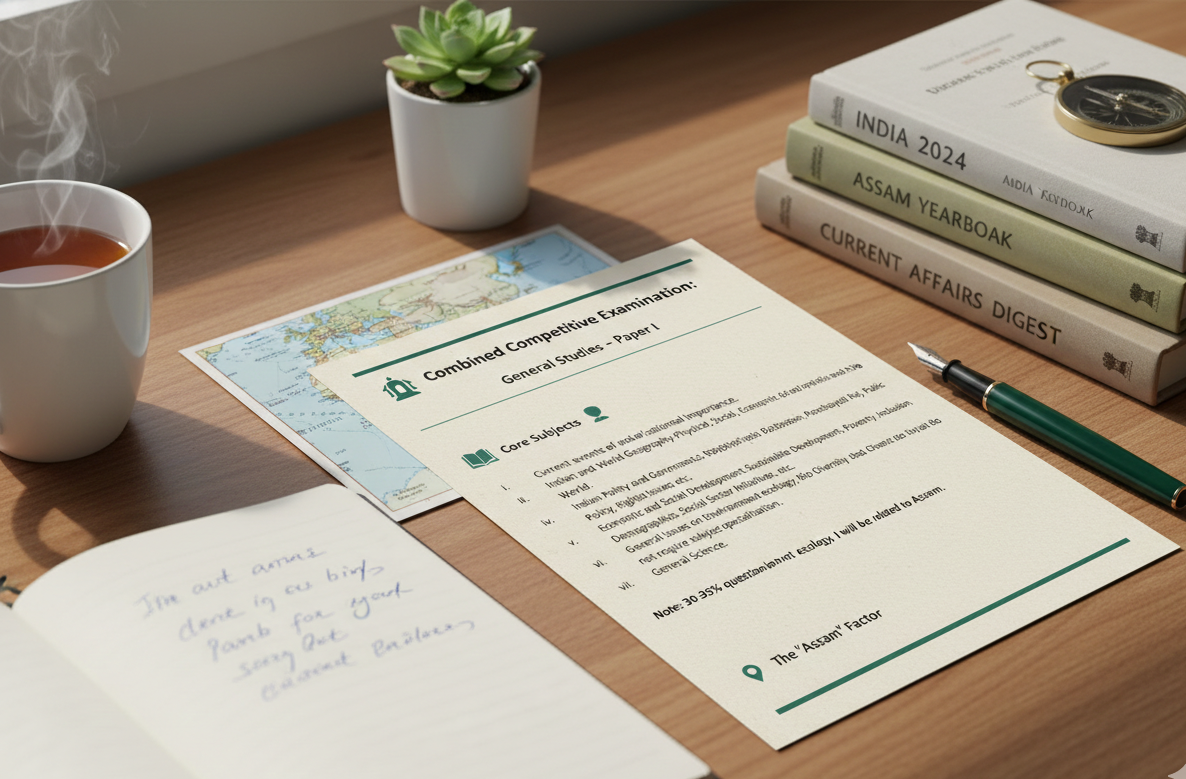
General Studies Paper I – Complete Syllabus
1. Current Events of National and International Importance
This includes:
- Government schemes
- Important bills and policies
- International developments
- Economic updates
- Assam-specific current affairs
APSC places strong importance on Assam’s current developments. State-specific news is not optional; it is essential.
2. History of India and Indian National Movement
- Art & Culture of Ancient History, Medieval History
- Modern Indian History
- Indian Freedom Movement
- Role of Assam in the Freedom Struggle
- Important personalities of Assam
Even though APSC Prelims 2024 did not include direct questions from Assam history, it does not mean the topic is irrelevant. APSC is highly unpredictable, and the commission can shift its focus anytime. Topics like the Ahom dynasty, Burmese invasion, Treaty of Yandaboo, socio-cultural reform movements, and regional struggles remain core areas of Assam’s historical identity and have been repeatedly asked in previous years. Skipping Assam history is like leaving guaranteed marks on the table in an exam where every mark matters.
3. Indian and World Geography
- Physical Geography
- Indian Geography
- Assam Geography
- Rivers, soil, and climate
- Natural resources
- Flood and disaster management
Assam’s geography is highly important. Questions from rivers, national parks, forest reserves, and climate patterns are common.
4. Indian Polity and Governance
- Constitution of India
- Fundamental Rights and Duties
- Parliament and State Legislature
- Governor and Chief Minister
- Panchayati Raj
- Constitutional and statutory bodies
- Assam administrative structure
Polity is one of the most scoring subjects if concepts are clear.
5. Economic and Social Development
- Indian economy basics
- Budget and taxation
- Inflation and unemployment
- Assam economy
- Poverty and development schemes
- Sustainable development
Conceptual clarity is more important than memorizing facts.
6. Environment, Ecology, and Biodiversity
- Climate change
- Environmental agreements
- Biodiversity conservation
- National Parks of Assam
- Kaziranga, Manas, Dibru-Saikhowa
Environmental awareness has increased in recent APSC papers.
7. General Science
- Basic physics, chemistry, and biology
- Everyday science
- Science and technology developments
- Space and biotechnology
Questions are usually conceptual and application-based.
General Studies Paper II (CSAT) – Syllabus
This paper tests aptitude and reasoning ability.
Topics include:
- Reading comprehension
- Logical reasoning
- Analytical ability
- Decision making
- Basic numeracy (Class 10 level)
- Data interpretation
Minimum qualifying marks: 33%.
It is qualifying, but it is not easy. Many candidates fail here because they assume it is simple.
Why Many Aspirants Fail in APSC Prelims
Let us be honest—most aspirants do not fail APSC Prelims because they are weak students.
They fail because they prepare in the wrong direction.
Below are the biggest mistakes that repeatedly cost candidates their Prelims qualification.
1. Ignoring Assam-Specific Topics
APSC is not UPSC. Assam-specific content is the game-changer.
Many aspirants focus only on national topics and forget that APSC heavily asks questions from:
- Assam History (Ahom period, Freedom Movement in Assam, Tribal history)
- Assam Geography (Brahmaputra system, national parks, border issues)
- Assam Economy and Schemes
- Culture, festivals, tribes, and heritage
Example:
Questions like:
- “Which tribe practices the Ali-Aye-Ligang festival?”
- “Which river is known as the lifeline of Upper Assam?”
Candidates who ignore Assam topics lose 20–30 marks easily, which is enough to fail Prelims.
2. Not Practicing MCQs Regularly
Many students only read books but never practice MCQs.
APSC Prelims is not a theory exam—it is an MCQ battle.
Without practice:
- You become slow
- You panic in the exam
- You cannot eliminate options effectively
Example:
A student may know the concept of Indian Polity, but in the exam, the options confuse them.
Only MCQ practice trains your brain to think in exam mode.
Reading builds knowledge.
MCQ practice builds selection.
3. Poor Time Management
APSC Prelims has a limited time and many questions.
Many aspirants either:
- Spending too much time on tough questions
- Or rush and make silly mistakes
Example:
If you spend 3 minutes on one difficult question, you lose time for 5 easy questions.
Toppers follow the rule:
- Easy → Medium → Tough
- Never get stuck on one question.
4. Over-Attempting Questions
Some aspirants think attempting more questions guarantees success.
This is dangerous due to negative marking.
Example:
Attempting 95 questions with 30 wrong answers can score less than attempting 75 questions with 10 wrong answers.
Smart aspirants attempt questions with:
- Clear knowledge
- Logical elimination
- High probability
APSC rewards accuracy, not bravery without logic.
5. Neglecting CSAT (Paper II)
Many candidates assume CSAT is easy and ignore it.
But every year, aspirants fail because they don’t clear the qualifying cut-off.
CSAT includes:
- Comprehension
- Basic Maths
- Reasoning
- Data interpretation
Example:
Even if you score very high in GS Paper I, failing CSAT means disqualification.
CSAT is a gatekeeper—you must clear it to stay in the race.
6. Studying Without Analyzing the Syllabus and Previous Year Papers
Many aspirants read random books without understanding what the APSC actually asks.
APSC repeats themes:
- Assam polity and governance
- Local economy and schemes
- Environment and biodiversity
- Basic static subjects
Example:
If you analyze past papers, you will see repeated questions on:
- Kaziranga and Manas National Park
- Assam budget and schemes
- Constitution and governance
Without a syllabus and PYQ analysis, you waste time on low-priority topics.
Final Truth About APSC Prelims
Prelims are not about studying more books than others.
It is about studying the right things, in the right way, repeatedly.
Those who:
- Focus on Assam-specific topics
- Practice MCQs daily
- Manage time smartly
- Avoid blind guessing
- Prepare CSAT seriously
- Analyze syllabus and PYQs
They qualify for Prelims.
Others keep repeating attempts.
The Turning Point in Your APSC Journey
At some point, every serious aspirant realizes something important.
Self-study requires effort.
Guidance gives direction.
Many candidates prepare for years without understanding where they are going wrong. The APSC Prelims demands focused preparation, structured mock practice, and an Assam-oriented strategy.
This is where the right mentorship changes everything.
Why You Should Join Borthakur IAS Academy for APSC 2026
If your goal is not just to attempt APSC but to qualify it, then random preparation is risky.
Borthakur IAS Academy provides:
- Assam-focused preparation strategy
- Integrated Prelims and Mains approach
- Structured syllabus coverage
- Regular mock tests with analysis
- Personal mentorship and doubt clearing
- Focused current affairs with Assam orientation
Success in APSC does not come from reading more. It comes from reading right, revising right, and practicing right.
If you truly want to see your name in the APSC merit list, make a serious decision today.
Join Borthakur IAS Academy and prepare with clarity, strategy, and confidence.
Your APSC journey does not begin with filling a form.
It begins with choosing the right guidance.