


Ask anyone in rural Boko or Rangapara what changed in their life over the past year, and land records or a caste certificate might come up before politics does. That’s the quiet, deliberate design behind one of Assam’s most significant administrative experiments in recent memory: the co-district system of Assam. For APSC aspirants, this isn’t just a current affairs headline — it’s a governance case study that touches decentralisation, citizen-centric administration, and the Assam government’s own stated ambition to be a national first-mover in local governance reform.
What exactly is a co-district of Assam ?
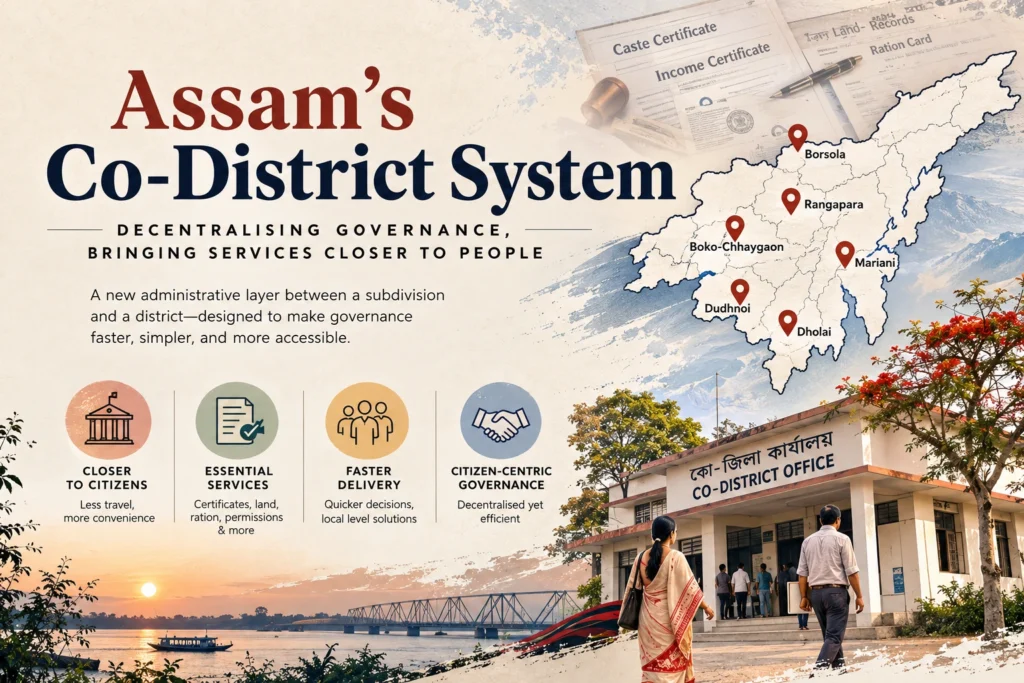
A co-district of Assam sits in a new administrative slot — above a sub-division, below a full-fledged district. It’s headed by a Co-District Commissioner and is designed to bring a district-level office physically closer to people who would otherwise travel long distances to a district headquarters for routine paperwork.
Assam has 35 formal districts. But not every Assembly constituency has its own district office nearby. The co-district model fills that gap without going through the longer, more complicated legal process of carving out an entirely new district. In effect, it decentralises administrative delivery while keeping the existing district map intact.
When was this rolled out, and how many co-districts does Assam have now?
Rollout Co-Districts of Assam
The rollout of Assam’s co-districts was carried out in two phases:
- Phase I (4–5 October 2024):
- 39 co-districts became operational.
- These were carved out of 21 parent districts.
- The rollout covered Upper Assam, Central Assam, Lower Assam, and the Barak Valley.
- Phase II (12–13 August 2025):
- 10 additional co-districts were inaugurated:
- Kamrup: Boko-Chhaygaon, Palashbari
- Sonitpur: Borsola, Rangapara
- Jorhat: Mariani, Teok
- Tinsukia: Makum, Digboi
- Cachar: Dholai
- Goalpara: Dudhnoi
- This expanded the total number of co-districts in Assam to 49.
- 10 additional co-districts were inaugurated:
Government’s Long-Term Vision on the Co-districts of Assam
Chief Minister Himanta Biswa Sarma has outlined the state’s long-term plan to expand the co-district system:
- Establish around 78 co-districts across Assam.
- Ensure that nearly every Assembly constituency without an existing district headquarters has a co-district headquarters.
- Sixth Schedule areas and the Bodoland Territorial Region (BTR) are currently excluded from this expansion plan.
Why did Assam introduce co-districts instead of just creating new districts?
Creating a new district is a lengthy administrative process. It usually requires Cabinet approval, official boundary notifications, and the establishment of a complete administrative structure with all government departments.
A co-district of Assam, on the other hand, can be set up much more quickly. The Assam government has introduced it as a way to decentralise administration and bring government services closer to people, without changing the state’s district boundaries.
Chief Minister Himanta Biswa Sarma has described the co-district model as a first-of-its-kind administrative initiative in India, as no other state currently has a similar level of administration between a sub-division and a district. For APSC aspirants, it is important to understand both the government’s claim that this is an innovative governance reform and the concerns and criticisms raised by its opponents.
What powers and services do co-districts of Assam actually handle?
This is the most important aspect of the co-district model, as it shows how decentralisation works in practice. By shifting key administrative functions closer to people, co-districts aim to make government services more accessible and reduce the need to visit district headquarters.
Co-district offices are empowered to:
- Issue important certificates, including:
- Caste Certificate
- Income Certificate
- Non-Creamy Layer (NCL) Certificate
- Permanent Resident Certificate (PRC)
- Next of Kin Certificate
- Exercise magisterial powers at the local level.
- Handle land revenue matters, including granting permission for the sale and purchase of land.
- Issue ration cards and manage benefits under the Public Distribution System (PDS).
- Grant permission for public meetings, fairs, and other events.
- Manage disaster response, including flood relief and compensation for fire-related losses.
The main objective of the Co-District of Assam, according to Chief Minister Himanta Biswa Sarma, is to bring government services closer to the people, ensuring that citizens can access essential administrative services without having to travel to the district headquarters.
What Are The Criticism and Concerns About the Co-District of Assam?
While the co-district of Assam initiative has been welcomed as a step towards decentralisation, it has also attracted criticism and raised several concerns.
Some of the key issues include:
- Concentration of powers: Critics argue that Co-District Commissioners have been given extensive powers, leading to concerns about how responsibilities are shared between the co-district administration and the parent district administration.
- Rapid implementation: The government launched a large number of co-districts within a short period. Some observers question whether sufficient staff, infrastructure, and resources were in place before they became operational.
- Implementation challenges: There are concerns that the announcement of co-districts may have moved faster than the actual development of offices, manpower, and service delivery mechanisms.
For APSC Mains, it is important to present a balanced view on Co-district While the co-district model has the potential to improve administrative accessibility and bring governance closer to the people, its long-term success will depend on adequate staffing, infrastructure, financial support, and effective coordination with the parent district administration. This balanced analysis can strengthen answers in both Governance and Assam-specific papers.
Why Is the Co-District Model Important for APSC and UPSC Mains?
The co-district model is an important topic for both APSC Mains and UPSC Mains, particularly under GS Paper II. It is relevant to themes such as governance, government policies and interventions, administrative reforms, decentralisation of power, citizen-centric administration, and last-mile service delivery.
For APSC, the topic on the Co-Districts of Assam is especially significant because it is a unique administrative reform introduced by the Assam government. For UPSC, the Co-district topic serves as a useful case study of state-level governance innovation, which can be cited in answers on decentralisation, public administration, and cooperative federalism.
How Can This Topic of Co-District of Assam Be Asked in APSC or UPSC Mains?
The Commission may frame questions on Co-District of Assam in several ways, such as:
- Direct questions on the co-district model, its objectives, features, and administrative structure.
- Comparative questions asking candidates to compare the co-district model with the Panchayati Raj system, district administration, or the sub-divisional administrative setup as mechanisms for decentralisation.
- Analytical or evaluative questions examining whether co-district genuinely strengthen grassroots governance and improve service delivery or simply create an additional administrative layer.
- Case study-based questions on administrative reforms, citizen-centric governance, or last-mile delivery, where Assam’s co-district model can be used as an example.
- Context-based questions linking the initiative with Assam’s broader administrative reforms, including the 2023 creation of new districts, delimitation-related changes, and the realignment of revenue circles with Assembly constituencies.
For both APSC and UPSC, candidates should go beyond memorising facts. They should be able to explain the objectives, advantages, challenges, and governance implications of the co-district model, while presenting a balanced assessment supported by relevant examples.
Sample APSC Mains-style practice question
“Assam’s co-district model has been described as a first-of-its-kind decentralisation initiative in India. Critically examine its objectives, functions, and the challenges it poses for effective grassroots governance.” (250 words)
A strong answer here would move beyond listing functions — it would engage with the administrative rationale (why not simply create new districts), weigh the efficiency gains against concerns about overlapping authority and implementation capacity, and place the reform within Assam’s wider pattern of post-delimitation administrative restructuring.
The bigger picture of the Co-District of Assam
The co-district of Assam model represents an important experiment in administrative decentralisation and citizen-centric governance in Assam. However, as a relatively new initiative, its long-term effectiveness will depend on how well it addresses challenges related to manpower, infrastructure, resource allocation, and coordination with existing administrative structures.
For APSC and UPSC aspirants, the co-district system should be viewed not merely as a factual topic but as an evolving case study of governance reform, last-mile service delivery, and administrative innovation. As Assam expands the model further, its success will ultimately be measured by whether it genuinely brings government closer to citizens and improves the efficiency of public service delivery.