


The Dream That Begins at Dawn
Picture this: it is 4:30 in the morning in a modest home in Guwahati. A young student named Priya — daughter of a schoolteacher and a homemaker — is already awake, her desk lamp casting a warm golden circle on a stack of books. One of those books is the UPSC Civil Services syllabus. The other is the APSC Combined Competitive Examination guide. She stares at both, pen tapping nervously on the desk, and asks herself the very question that has kept her up at night for months:

“Which one should I prepare for first — UPSC or APSC? And honestly, which one is harder?”
Priya’s story is not unique. Every year, hundreds of thousands of aspirants — particularly from the northeastern states of India — grapple with this same dilemma. The debate around UPSC vs APSC is more than just an academic comparison. It is a life-defining crossroads. It is a decision that shapes careers, sacrifices, and futures.
This blog is written for every Priya out there. We will walk through the depths of both examinations — their history, structure, difficulty, preparation demands, and what it really means to crack them — so that by the time you finish reading, you have a clear, honest picture of what you are signing up for.
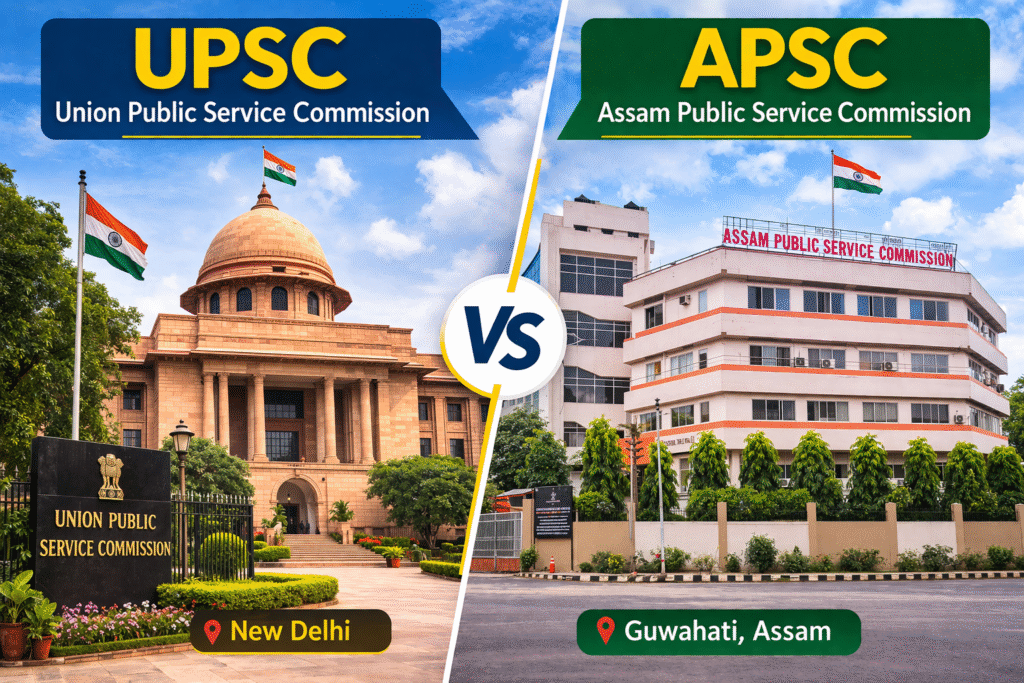
UPSC vs APSC: Understanding the Two Titans
Before we dive into the comparison of UPSC vs APSC, let us understand what each of these examinations represents and why both are deeply significant in the Indian administrative landscape.
The Union Public Service Commission, more commonly known as UPSC, is the constitutional body responsible for recruiting officers for the All India Services and the Central Services. It is often called the ‘Mother of All Examinations’ in India — and for very good reason. The UPSC Civil Services Examination (CSE) is conducted once a year and selects candidates for coveted posts such as the Indian Administrative Service (IAS), Indian Police Service (IPS), Indian Foreign Service (IFS), Indian Revenue Service (IRS), and dozens of other Group A and Group B Central Services.
On the other side of this great comparison of UPSC vs APSC stands the Assam Public Service Commission — APSC — the state-level body that conducts the Combined Competitive Examination (CCE) for recruitment into the Assam Civil Services (ACS), Assam Police Service (APS), Assam Finance Service, and other Group A and Group B posts within the Government of Assam. While APSC may not carry the same national prestige as UPSC, it is immensely respected and deeply coveted within Assam and the northeastern region.
The Historical Context: How Did These Giants Come to Be?
Understanding the history of both examinations gives you a deeper appreciation of why the UPSC vs APSC debate matters so profoundly to civil service aspirants.
The UPSC was established under Article 315 of the Indian Constitution in 1950, taking over from the colonial-era Federal Public Service Commission. Its roots go back even further, to the Indian Civil Service (ICS) examination introduced by the British government in 1858. The British designed this system to recruit brilliant administrators, and independent India inherited — and evolved — this tradition.
APSC, meanwhile, was established in 1937 under the Government of India Act, 1935, making it one of the older public service commissions in the country. For the people of Assam, APSC is not just an examination body — it is a gateway to serving their own land, their own communities, in their own language and culture. This emotional connection makes the UPSC vs APSC debate particularly poignant for Assamese aspirants.
UPSC vs APSC: A Structural Breakdown Side by Side
Let us now lay out the structural framework of both examinations clearly. Before we dive deep into storytelling and analysis, here is a factual comparison table that places UPSC vs APSC side by side:
| Factor | UPSC | APSC |
| Conducting Body | Union Public Service Commission | Assam Public Service Commission |
| Level | National | State (Assam) |
| Posts Offered | IAS, IPS, IFS, IRS & more | ACS, APS, Assam Finance Service, etc. |
| Stages | Prelims, Mains, Interview | Prelims, Mains, Interview |
| Syllabus Scope | Vast – Pan-India + Global | State-focused + National basics |
| No. of Vacancies | ~900–1000 per year | ~50–200 per year |
| Competition Level | ~10–13 lakh applicants | ~1.5–3 lakh applicants |
| Interview (Personality Test) | 275 marks | 150–200 marks (varies) |
| Optional Subject | Yes – 2 papers (250 marks each) | Yes – varies by notification |
| Frequency | Once a year | Irregular / when vacancies arise |
This table gives you the skeleton. But numbers and rows never tell the full story. To truly understand UPSC vs APSC, we need to look at the flesh and bone — the syllabus, the preparation culture, the success rates, and the emotional weight of both journeys.
The Syllabus Saga: Where the Real Battle Is Fought
UPSC vs APSC: The Syllabus Showdown
If you were to measure the sheer volume of knowledge demanded by each exam, UPSC wins — by a wide margin. But it would be unfair and intellectually dishonest to stop the UPSC vs APSC debate there. Let us walk through the syllabi carefully.

The UPSC Civil Services Examination unfolds in three stages: the Preliminary Examination (Prelims), the Main Examination (Mains), and the Personality Test (Interview). The Prelims consists of two papers — General Studies Paper I and CSAT (Civil Services Aptitude Test). General Studies Paper I alone covers History, Geography, Polity, Economy, Environment, Science & Technology, and Current Affairs spanning India and the globe. The CSAT tests analytical ability, reading comprehension, and logical reasoning.
The Mains examination is where the true intellectual marathon begins. It consists of nine papers — four General Studies papers covering the entire range of topics in extraordinary depth, one Essay paper, two optional subject papers (from a list of 48 subjects), and two language papers. The sheer breadth of topics means that a UPSC aspirant must be conversant with Indian History from the Harappan civilisation to the present day, global events and geopolitics, constitutional provisions, economic theories, environmental science, ethics and governance, and much more.
APSC’s Combined Competitive Examination follows a similar three-stage structure: Preliminary Examination, Mains, and Interview. However, the scope is considerably more state-centric. While the APSC syllabus does include national topics — Indian Polity, Indian Economy, General Science — it places significant emphasis on the History, Culture, Economy, and Current Affairs of Assam specifically. Questions on the Assamese language, the geography of the Brahmaputra valley, the tea industry, tribal communities of Assam, and northeastern affairs are integral parts of the APSC exam.
“The UPSC expects you to understand the world. The APSC expects you to understand Assam — and that, too, is no small task.”
For an aspirant from Assam who has grown up knowing Assamese history and culture, this regional focus of APSC can be a significant advantage compared to a student from Bihar or Maharashtra appearing for the same exam. In the UPSC vs APSC competition, familiarity with local context can tip the scales.
The Numbers Game: Competition and Success Rates
UPSC vs APSC: How Fierce Is the Competition?
Let us go back to Priya, sitting at her desk in the early hours. She pulls up the statistics on her phone and the numbers stare back at her, cold and unrelenting.
Every year, approximately 10 to 13 lakh (one to 1.3 million) candidates register for the UPSC Civil Services Preliminary Examination. Of these, only around 5 to 6 lakh actually appear. The Mains stage sees approximately 13,000 to 15,000 candidates, and finally, around 2,000 to 2,500 are called for the interview. Against this funnel, only about 900 to 1,000 candidates are finally selected — making the overall success rate less than 0.1%. In simpler terms, fewer than 1 in every 1,000 applicants clears the UPSC Civil Services Examination.
APSC’s numbers are different in scale but not necessarily in competitiveness. For a typical APSC CCE notification, roughly 1.5 to 3 lakh candidates apply. The number of vacancies varies greatly — sometimes as few as 50, sometimes reaching 200 or more. The success rate is marginally higher in absolute percentage terms, but the competition remains fierce, and in certain years when vacancies are very limited, the difficulty of clearing APSC rivals UPSC’s intensity.
| Key Insight: UPSC vs APSC Competition While UPSC has a national-level applicant pool running into millions, APSC’s smaller candidate base does not necessarily translate into an easier path. With fewer vacancies and a highly motivated regional applicant pool — many of whom have also prepared for UPSC — the APSC examination demands rigorous preparation in its own right. |
There is another dimension to the UPSC vs APSC comparison that aspirants often overlook: the quality of competition. In UPSC, you are competing against the best minds from across India — IIT graduates, lawyers, doctors, engineers, and humanities scholars who have spent years preparing. In APSC, while the pool is smaller, many of the top competitors are those who have already attempted UPSC and bring that level of preparation to the state examination. This makes APSC far more competitive than its numbers alone suggest.
The Preparation Journey: Years of Sacrifice
UPSC vs APSC: How Long Does Preparation Really Take?
Meet Rahul, another aspirant from Jorhat, Assam. He graduated with a degree in Political Science and immediately began preparing for UPSC. Three years in, after multiple attempts, Rahul has cleared the APSC Mains but has not yet crossed the UPSC Prelims threshold. His story is a perfect window into how the preparation timelines for UPSC vs APSC differ — and overlap.
For UPSC, most serious aspirants spend anywhere between one and a half to three years in focused preparation before their first serious attempt. The vast volume of the syllabus — particularly the optional subject papers, essay writing skills, answer writing practice, and current affairs tracking — demands a sustained, multi-year investment of time and energy. Coaching institutes in Delhi, Hyderabad, Bengaluru, and Guwahati are filled with aspirants who have taken breaks from their careers, relocated to new cities, and restructured their entire lives around UPSC preparation.
APSC preparation, while overlapping significantly with UPSC in terms of general topics, requires a focused additional layer of Assam-specific knowledge. Many aspirants integrate APSC preparation as a parallel track to UPSC — using their UPSC foundation and adding the state-specific content. This dual preparation strategy is common in Assam, and it reflects the interconnected nature of UPSC vs APSC as aspirational pathways.
However, for aspirants who choose to focus exclusively on APSC, a dedicated preparation timeline of 12 to 18 months is often cited as sufficient — provided the candidate has a strong academic foundation. The relatively tighter syllabus scope means that mastery is achievable in a shorter timeframe compared to UPSC.
“The UPSC journey is a marathon across mountains. The APSC journey is a marathon through the lush valleys of Assam — equally exhausting, differently demanding.”
— A veteran civil service coaching mentor
The Interview Round: Where Personalities Are Tested
UPSC vs APSC: The Personality Test Compared
Both UPSC and APSC have a final stage that goes beyond books — the Personality Test, more commonly called the Interview. This is where the examiners probe not just your knowledge, but your character, your leadership potential, your communication skills, and your suitability for public service.
The UPSC interview, officially called the Personality Test, carries 275 marks. It is conducted by a Board of experienced civil servants and often lasts between 25 and 45 minutes. The questions can range from your graduation subject and hometown to global geopolitics, current policy debates, ethical dilemmas, and abstract philosophical questions. The UPSC interview board is looking for intellectual honesty, clarity of thought, composure under pressure, and genuine commitment to public service.
The APSC interview, while structurally similar, carries relatively fewer marks and tends to have a stronger focus on Assam-specific topics — the issues facing the state, its development challenges, its cultural heritage, and the aspirant’s vision for Assam’s future. For a candidate who knows Assam deeply — who has lived its challenges and loves its landscape — the APSC interview can actually feel more natural and authentic than UPSC’s interview.
In the ongoing UPSC vs APSC debate, many successful APSC officers candidly admit that the UPSC interview is a more high-stakes, more nerve-wracking experience because it tests a broader range of knowledge and places you before a more formidable board. Yet the APSC interview, with its regional depth, demands its own kind of mastery.
The Irregularity Problem: APSC’s Unique Challenge
UPSC vs APSC: The Calendar Crisis
Here is something that rarely gets discussed in the UPSC vs APSC debate but is critically important for any aspirant considering APSC: the examination calendar.
UPSC is remarkably consistent. The UPSC Civil Services Examination notification is released every year, typically in February, the Prelims is held in June, the Mains in September, and results are declared in April of the following year. This predictability allows aspirants to plan their preparation with military precision.
APSC, unfortunately, has historically struggled with consistency. Notifications have been delayed, examinations have been rescheduled, results have been held up for months or even years due to court cases, administrative challenges, or changes in government policy. There have been instances where APSC CCE results were delayed by two to three years after the examination — a limbo that left thousands of aspirants in agonizing uncertainty.
| Important Consideration for APSC Aspirants The irregular scheduling and historical delays in the APSC CCE process are a significant factor in the UPSC vs APSC decision. Aspirants must mentally and financially prepare for the possibility that the APSC process may not follow a predictable timeline. This uncertainty makes dual preparation — for both UPSC and APSC — a common and pragmatic strategy among serious aspirants from Assam. |
This unpredictability has led many Assamese aspirants to approach UPSC and APSC simultaneously — using one as the primary goal and the other as a parallel track. The intersection of UPSC vs APSC preparation is not just about shared syllabus; it is about shared sacrifice, shared uncertainty, and shared hope.
The Perks and the Postings: What You Gain
UPSC vs APSC: Career, Prestige, and Purpose
Let us talk about what actually happens when you crack these examinations — because the destination matters as much as the journey.
A successful UPSC candidate who secures an IAS rank is posted across the country. An IAS officer from Assam may spend years in Rajasthan, Karnataka, or Delhi before returning home. The posting is decided by the government and the cadre allotted. The prestige, the national reach, the power to influence national-level policy — these are extraordinary. IAS officers have the authority to shape how thousands of crores of government money is spent and how millions of lives are impacted. The scope of UPSC’s reward is truly national.
An APSC officer, meanwhile, serves Assam directly. The ACS officer is at the heart of district administration, working on flood relief, land record management, revenue collection, disaster management, and local governance. For someone who is deeply rooted in Assam — who wants to serve their own people, in their own land, in a language they grew up speaking — APSC is not a lesser choice. It is a deeply meaningful one.
In the UPSC vs APSC comparison of career outcomes, what matters is the aspirant’s vision for their career. Those who dream of a pan-India or international role lean towards UPSC. Those who are driven by a love for Assam and a desire to transform it from within choose APSC as their primary goal.
“Serving your own soil is not a smaller dream. It is a different kind of greatness.”
— A retired ACS officer, Assam
The Emotional Weight: Which Journey Demands More From You?
UPSC vs APSC: The Human Cost of Preparation
No honest discussion of UPSC vs APSC can ignore the human cost — the emotional, psychological, and financial burden that both examinations place on aspirants and their families.
UPSC preparation is widely acknowledged as one of the most emotionally intense journeys a young Indian can undertake. With a maximum attempt limit (six for General category candidates), every failure carries enormous weight. The pressure of competing against the nation’s brightest, while watching peers advance in their careers or professional lives, creates what many psychologists and counsellors working with civil service aspirants describe as ‘aspirant burnout.’ Stories of aspirants who spent five or six years preparing and ultimately could not clear UPSC are tragically common — and yet, their preparation often equipped them with skills and knowledge that served them brilliantly in other careers.
APSC preparation, while less discussed in national media, carries its own emotional weight. The delayed results, the uncertainty of notification timelines, and the high stakes of a state where government employment is deeply valued — these factors combine to create significant stress. Families in Assam often invest enormously in coaching and preparation for APSC, viewing it as the primary pathway to stability and status.
In the UPSC vs APSC comparison of emotional demands, both examinations test not just your intelligence but your resilience, your patience, and your capacity to persevere without guarantees. The aspirant who succeeds in either examination is not merely the smartest person in the room — they are the most persistently determined.
Coaching and Resources: Are You Supported?
UPSC vs APSC: Coaching Ecosystem and Resources
The coaching ecosystem around UPSC is vast and well-established. From Mukherjee Nagar in Delhi to the countless online platforms, UPSC aspirants have access to comprehensive coaching, structured study plans, mock test series, interview guidance, and a massive community of fellow aspirants. The resources — books, video lectures, PDF notes, newspaper analysis — are plentiful and constantly updated.
The APSC coaching ecosystem, while growing, is more concentrated and less diverse. Guwahati has several reputable coaching institutes that specialize in APSC preparation, with a growing number of online platforms offering Assam-specific content. However, the sheer volume and variety of resources available for UPSC far exceeds what is currently available for APSC.
This resource disparity in the UPSC vs APSC ecosystem means that APSC aspirants sometimes have to be more self-reliant and creative in their preparation — gathering Assam-specific study material, following state government publications, reading regional newspapers like The Assam Tribune and Pratidin, and building their own notes on Assamese history and culture.
| Resource Tip for APSC Aspirants While UPSC resources form a strong foundation for APSC preparation, aspirants must supplement their study with dedicated Assam-specific resources. Key sources include: The Assam Year Book, publications by the Assam Government, Regional Geography of Northeast India, and Assam’s economic and developmental reports published by the State Planning Board. |
Which One Is Actually Harder? The Verdict
UPSC vs APSC: The Final Verdict
We have journeyed through history, syllabi, statistics, careers, emotions, and resources. Now comes the question that Priya — and every aspirant reading this — has been waiting for: between UPSC vs APSC, which examination is actually harder?
The honest answer is this: UPSC is objectively more difficult in terms of the breadth and depth of its syllabus, the scale of competition, the national prestige at stake, and the sheer volume of preparation it demands. By almost every measurable parameter, clearing UPSC — especially getting a top rank to secure the IAS or IPS — is harder than clearing APSC.
But ‘harder’ does not mean ‘impossible,’ and ‘easier’ does not mean ‘easy.’ The UPSC vs APSC debate is not a contest of which examination to dismiss. APSC is a formidable examination in its own right. With thousands of brilliant, motivated, often UPSC-prepared candidates competing for a small number of vacancies, APSC is by no means a walk in the park. For many aspirants, especially those who are deeply rooted in Assam, clearing APSC demands everything they have.
“Both UPSC and APSC demand the same fundamental virtues: discipline, depth, and determination. The difference is in the canvas — one is national, the other is regional. But both are painted with the same sweat.”
In the UPSC vs APSC comparison, what ultimately determines difficulty is personal: your background, your strengths, your goals, and your definition of success. For someone from Kerala with no connection to Assam, UPSC will feel more natural than APSC. For someone from Jorhat who grew up steeped in Assamese culture and wants to serve their community, APSC may be the more achievable and more fulfilling path.
Dual Preparation: The Smart Strategy for Assamese Aspirants
UPSC vs APSC: Can You Prepare for Both?
Given the significant syllabus overlap between UPSC and APSC, many aspirants from Assam successfully pursue both simultaneously. In the UPSC vs APSC preparation overlap, approximately 60 to 70 percent of UPSC’s General Studies content is directly relevant to APSC. Topics like Indian Polity, Indian Economy, Modern Indian History, General Science, Environment, and Disaster Management appear in both examinations.
The smart dual preparation strategy involves: first, building a strong UPSC foundation through General Studies and Current Affairs; second, dedicating specific time to APSC-specific content, especially Assam’s history, geography, culture, economy, and current affairs; and third, taking mock tests for both examinations separately to build examination-specific temperament.
Many successful civil servants from Assam have cleared both UPSC and APSC in the same preparation cycle — using one examination’s preparation to fuel the other. This synergy is one of the most powerful arguments for why Assamese aspirants should not see UPSC vs APSC as an either/or choice, but rather as complementary paths on the same journey.
A Letter to Every Aspirant
UPSC vs APSC: Your Journey, Your Choice
As the sun begins to rise over Guwahati, Priya closes her books. She has made her decision — not because someone told her which exam was harder, but because she finally understands what each one means.
She will prepare for UPSC because she wants to understand and serve India. And she will simultaneously prepare for APSC because she loves Assam — its tea gardens, its rivers, its festivals, its people. She does not see UPSC vs APSC as a battle. She sees them as two roads that ultimately lead to the same destination: a life of purpose, service, and impact.
If you are reading this and you are at the beginning of your journey, here is what the UPSC vs APSC comparison ultimately teaches you: the examination you choose reflects the life you want to live. Both paths are honourable. Both demand sacrifice. Both reward persistence. And both produce officers who, at their best, transform the lives of the people they serve.
“Don’t ask which exam is harder. Ask which dream is yours. Then prepare like your life depends on it — because in many ways, it does.”
The UPSC vs APSC debate will continue in coaching classes, WhatsApp groups, and family dining tables across Assam for years to come. But the real answer to ‘which is harder?’ is personal, contextual, and ultimately irrelevant — because the real question is: Are you willing to work hard enough to clear either one?
FAQs on UPSC vs APSC
Is APSC syllabus a subset of UPSC syllabus?
Largely, yes. About 60–70% of APSC’s General Studies content overlaps with UPSC. However, APSC has a significant portion dedicated to Assam-specific topics that are not part of UPSC’s syllabus. So UPSC preparation provides a strong base, but does not completely cover APSC requirements.
Can I appear for both UPSC and APSC in the same year?
Yes, and many aspirants do exactly this. Since the examination dates typically do not clash, it is possible to appear for both UPSC Prelims and APSC Prelims in the same preparation cycle. This dual attempt strategy is quite common among serious aspirants from Assam.
Which exam has better job security — UPSC or APSC?
Both examinations lead to gazetted government officer positions with excellent job security, perks, and social respect. UPSC officers (IAS, IPS) generally have higher pay scales, more perks, and greater national mobility. APSC officers serve within Assam and have the advantage of serving in their home state.
How many attempts are allowed for UPSC vs APSC?
For UPSC, General category candidates get 6 attempts up to the age of 32. OBC candidates get 9 attempts up to 35. SC/ST candidates get unlimited attempts until age 37. For APSC, the attempt limits and age criteria differ — General category candidates typically have more attempts allowed up to a higher age limit. Always check the latest official notification for current rules.
Is the medium of examination different for UPSC vs APSC?
UPSC allows candidates to write their Mains examination in any of the 22 Scheduled Languages of India, in addition to English. APSC also allows Assamese and English as mediums, with Assamese being a natural choice for most Assam-based aspirants. The language medium choice can significantly affect an aspirant’s performance and comfort.