

The Act East Policy is India’s flagship foreign-policy initiative. It aims to deepen economic, strategic, and cultural ties with Southeast Asia, East Asia, and the wider Indo-Pacific. Launched in November 2014 as an upgraded, action-oriented version of the earlier Look East Policy, it places India’s North Eastern Region (NER) — with Assam as its anchor — at the very centre of the strategy, treating the region as the country’s land bridge to ASEAN.
Because the policy sits at the intersection of international relations and Northeast India’s development, it is a high-yield topic for both UPSC Civil Services (GS Paper II — International Relations) and the Assam Public Service Commission (APSC) and other State PSC exams, where the Northeast and Assam angle carries added weight. In this article, we will discuss the objectives, pillars, key projects, significance, and challenges — with a dedicated section on Assam and the Northeast.
What Is the Act East Policy?
The Act East Policy is a diplomatic and economic strategy of the Government of India aimed at strengthening relations with countries of Southeast Asia, East Asia, and the Indo-Pacific through sustained engagement at bilateral, regional, and multilateral levels. It was announced by Prime Minister Narendra Modi at the 12th ASEAN-India Summit and the 9th East Asia Summit in Myanmar in November 2014.
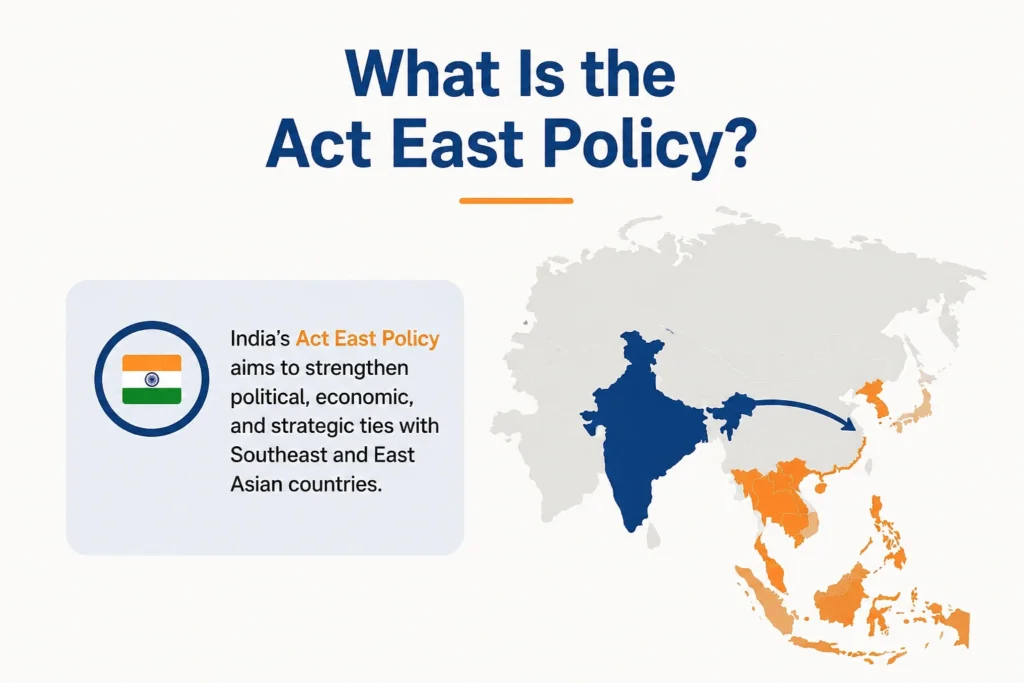
The name signals the core idea: India moved from merely “looking” east (passive observation) to actively “acting” east (proactive participation). The policy expands engagement beyond trade to include connectivity, defence, security, culture, and people-to-people links, with ASEAN as its central pillar.
Quick facts:
| Feature | Detail |
| Launched | November 2014 |
| Announced by | PM Narendra Modi (ASEAN-India & East Asia Summits, Myanmar) |
| Predecessor | Look East Policy (1991–92, PM P. V. Narasimha Rao) |
| Nodal ministry | Ministry of External Affairs (MEA) |
| Central pillar | ASEAN (Association of Southeast Asian Nations) |
| Core framework | 4 C’s — Culture, Commerce, Connectivity, Capacity Building |
| Domestic focus | North Eastern Region as gateway to Southeast Asia |
Background: From Look East to Act East
After the disintegration of the USSR in 1991 and the end of the Cold War, India needed to realign its economic and strategic partnerships. In 1992, Prime Minister P. V. Narasimha Rao launched the Look East Policy to boost engagement with a fast-growing Southeast Asia, establish India as a regional power, and balance China’s rising influence. Its emphasis was largely economic — trade and investment ties with ASEAN.
Over two decades, India became a Sectoral, then Full Dialogue Partner of ASEAN, joined the ASEAN Regional Forum (ARF) in 1996, and began annual ASEAN-India Summits from 2002. Building on this base, the Act East Policy (2014) widened both the geography (adding East Asia, Australia, and Pacific nations) and the agenda (adding security, connectivity, and culture).
Look East vs Act East Policy
| Aspect | Look East Policy (1992) | Act East Policy (2014) |
| Launched by | P. V. Narasimha Rao | Narendra Modi |
| Primary focus | ASEAN + economic integration | ASEAN + East Asia + Indo-Pacific; strategic + cultural |
| Approach | Passive, observational | Proactive, action-oriented |
| Security cooperation | Limited | Central (maritime security, defence, Quad) |
| Strategic aim | Regional power, counterweight to China | Freedom of navigation, Indo-Pacific stability |
| Domestic linkage | Modest | Northeast India as the gateway to ASEAN |
Objectives of the Act East Policy
The Act East Policy pursues several interlinked objectives:
- Economic engagement — expand trade, investment, and market access with ASEAN and East Asian economies, and integrate India into global and regional supply chains.
- Strategic partnerships — build durable security and defence ties through bilateral and multilateral dialogues.
- Connectivity — develop cross-border road, rail, air, maritime, and digital links, especially through the Northeast.
- Cultural and people-to-people ties — leverage shared Buddhist and Hindu civilizational heritage, education, and diaspora links.
- Regional cooperation — collaborate on shared challenges like terrorism, maritime security, disaster management, and climate change.
- Development of the Northeast — position the NER as India’s bridge to Southeast Asia and drive its economic growth.
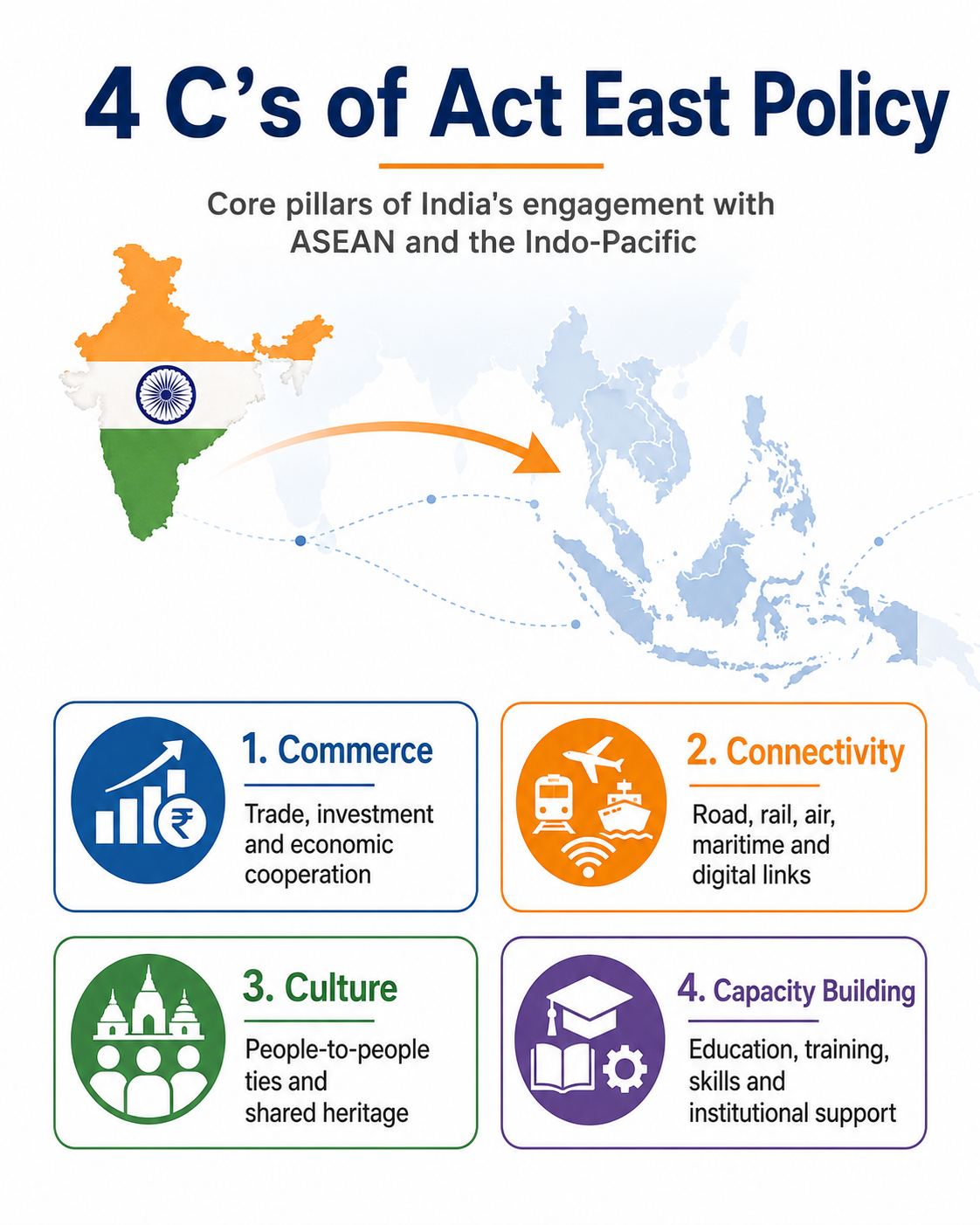
The 4 C’s of the Act East Policy
The policy is popularly summarised through the 4 C’s — a frequently asked point in both UPSC and APSC exams:
- Culture — reviving civilizational and religious links (Buddhism, Hinduism) with Southeast Asia.
- Commerce — boosting trade, investment, and economic integration.
- Connectivity — physical and digital infrastructure linking India with the region.
- Capacity Building — training, skill development, and institutional support (e.g., ITEC) for partner nations.
India’s broader maritime vision under the policy is captured in SAGAR — “Security and Growth for All in the Region.“
Three Pillars of the Act East Policy
- Economic pillar — trade, investment, and integration with East and Southeast Asian supply chains.
- Socio-cultural pillar — mutual understanding through shared cultural and civilizational bonds.
- Political-security pillar — defence cooperation, regional stability, and maintaining a balance of power in the Indo-Pacific.
Key Features
- ASEAN-centric approach, with active participation in ARF, the East Asia Summit (EAS), and ADMM-Plus.
- Strategic partnerships with Japan, Vietnam, the Philippines, South Korea, and Australia.
- Maritime security focus, advocating freedom of navigation in vital sea lanes, including the South China Sea.
- Connectivity and infrastructure, through cross-border highways, rail links, waterways, and digital platforms.
- Multilateral engagement via ASEAN, BIMSTEC, the Mekong-Ganga Cooperation, and the Quad.
Major Projects and Initiatives under the Act East Policy
Several flagship connectivity projects operationalise the policy, most of them running through or benefiting the Northeast:
- India-Myanmar-Thailand Trilateral Highway — a road corridor linking Moreh (Manipur) through Myanmar to Mae Sot (Thailand), envisaged to extend to Cambodia, Laos, and Vietnam.
- Kaladan Multi-Modal Transit Transport Project — connects Kolkata to Sittwe port in Myanmar by sea, then to Mizoram via river and road, giving the landlocked Northeast an alternative route to the sea.
- Agartala-Akhaura Rail Link — links Tripura with Bangladesh, cutting travel distance between the Northeast and Bangladeshi ports.
- Brahmaputra & Barak inland waterways (National Waterway-2) — cargo and passenger movement along the Brahmaputra (Dhubri to Sadiya in Assam) and India-Bangladesh Protocol Routes.
- India-Japan Act East Forum (2017) — aligns India’s Act East Policy with Japan’s Free and Open Indo-Pacific strategy to modernise Northeast infrastructure.
- BBIN Motor Vehicles Agreement — seamless movement of goods and vehicles among Bangladesh, Bhutan, India, and Nepal.
- ITEC Programme & Quick Impact Projects (QIPs) — capacity building and small development projects in Cambodia, Laos, Myanmar, and Vietnam.
- International Buddhist Confederation (IBC) — promotes shared Buddhist heritage and cultural diplomacy.
Act East Policy and the Northeast: India’s Gateway to Southeast Asia
For Northeast India — comprising eight states (Assam, Arunachal Pradesh, Manipur, Meghalaya, Mizoram, Nagaland, Tripura, and Sikkim) — the Act East Policy is a transformative framework. The region shares nearly 98% of its borders with neighbouring countries (Myanmar, Bangladesh, Bhutan, Nepal, and China), which makes it the natural land bridge between mainland India and ASEAN.
The government has repeatedly described the Northeast as being “at the heart of the Act East Policy.” Its abundant resources — oil and natural gas, minerals, hydropower potential, tea, and biodiversity — combine with its strategic location to make it central to the policy’s success. Connectivity upgrades have been significant: national highway length in the region has expanded substantially over the past decade, and multiple rail, road, waterway, and air links are under development.
This Northeast dimension is exactly where the APSC and other State PSC exams place their emphasis, so aspirants should study the region-specific projects and economic linkages closely.
Act East Policy and Assam: The Anchor State
Assam occupies a special position within the Act East Policy as the largest economy and connectivity hub of the Northeast:
- “Advantage Assam” investment summits — the flagship Advantage Assam 2.0 summit (February 2025) branded the state as “India’s Expressway to ASEAN” and sought to position Assam and the Northeast as a global investment hub in energy, agriculture, tourism, and manufacturing.
- Brahmaputra waterway (NW-2) — the Dhubri-Sadiya stretch (~891 km) is being developed to boost cargo, tourism, and regional trade.
- Road corridors — Assam’s national highways (including stretches of the historic Stilwell Road and ASEAN Highway links via Dimapur-Kohima-Imphal) connect the region toward Myanmar and beyond.
- Guwahati as a regional hub — infrastructure such as multimodal logistics, air links, and urban projects reinforce Assam’s role as the gateway city.
- Special Development Packages for Assam (and Tripura) focus on infrastructure, employment, skill development, and tourism.
For APSC aspirants, Assam’s role illustrates how a national foreign policy translates into concrete state-level development — a theme well suited to State PSC mains answers.
Significance of the Act East Policy
- Counterweight to China — it strengthens India’s presence in Southeast Asia and the Indo-Pacific, offering partners an alternative to Chinese dominance, especially amid South China Sea tensions.
- Economic integration — deeper trade and investment ties with one of the world’s fastest-growing regions.
- Strategic outreach — landmark deals such as the BrahMos missile export to the Philippines signal India’s rising security role.
- Regional security architecture — active participation in the Quad, 2+2 dialogues, and ASEAN-led forums.
- Development of the Northeast — transforming a historically landlocked, underdeveloped region into a bridge for trade and growth.
- Soft power — leveraging Buddhist and Hindu civilizational links and the Indian diaspora.
Challenges to the Act East Policy
- Project delays — connectivity projects like the Trilateral Highway and Kaladan project face slow execution due to terrain, funding, and coordination issues.
- Instability in Myanmar — political turmoil and internal conflict disrupt land connectivity to Southeast Asia.
- China’s counter-strategy — Beijing’s “String of Pearls” and the China-Pakistan Economic Corridor (CPEC) seek to encircle India.
- Regional politics — changes of government in neighbours like Bangladesh can affect cooperation and initiatives such as BIMSTEC.
- Infrastructure and security gaps in the Northeast — insurgency, difficult terrain, and uneven development slow progress.
- Trade imbalances — India runs trade deficits with several ASEAN partners, and market access remains uneven.
Way Forward
- Expedite connectivity projects — fast-track the Trilateral Highway, Kaladan project, and rail links to unlock the Northeast’s potential.
- Deepen maritime engagement — expand cooperation with ASEAN and the Quad and develop ports like Sabang (Indonesia) near the Strait of Malacca.
- Leverage soft power — use shared Buddhist and Hindu heritage and diaspora links for cultural diplomacy.
- Empower the Northeast — align state development plans (especially Assam’s) with the policy for local jobs and inclusive growth. It ensures benefits reach remote areas, not just transit corridors.
- Strengthen institutions — reinforce BIMSTEC and Mekong-Ganga Cooperation as vehicles for regional integration.
Conclusion
The Act East Policy marks India’s evolution from a cautious observer to an active shaper of the Indo-Pacific order. By binding foreign policy to the development of the Northeast — with Assam as its expressway to ASEAN — the policy links India’s strategic ambitions with the aspirations of one of its most promising regions. Realising its full potential now depends on completing connectivity projects, managing regional volatility, and ensuring that growth genuinely reaches the people of the Northeast.
Also read –
Assam State Election Commission
FAQs on Act East Policy
What is the Act East Policy of India?
It is India’s foreign-policy initiative launched in November 2014 to strengthen economic, strategic, and cultural ties with Southeast Asia, East Asia, and the Indo-Pacific, with ASEAN at its centre and the Northeast as its gateway.
When and by whom was the Act East Policy launched?
It was launched in November 2014 by Prime Minister Narendra Modi, upgrading the Look East Policy started by P. V. Narasimha Rao in 1991-92.
What are the 4 C’s of the Act East Policy?
Culture, Commerce, Connectivity, and Capacity Building.
What is the difference between Look East and Act East Policy?
Look East (1992) was largely economic and ASEAN-focused; Act East (2014) is proactive and broader, adding East Asia, security cooperation, connectivity, and a strong Northeast/Indo-Pacific focus.
Why is the Northeast important to the Act East Policy?
The Northeast shares about 98% of its borders with neighbouring countries and serves as India’s land gateway to Southeast Asia, making it central to the policy’s connectivity and trade goals.
How does the Act East Policy benefit Assam?
Through investment summits like Advantage Assam 2.0, Brahmaputra waterway development, highway and rail connectivity, and special development packages that position Assam as India’s expressway to ASEAN.