


The Women’s Reservation Bill 2023, officially titled the Constitution (One Hundred and Twenty-Eighth Amendment) Bill, 2023 and popularly known as the Nari Shakti Vandan Adhiniyam, is one of the most significant constitutional reforms in the history of Indian democracy. Passed almost unanimously by both Houses of Parliament in September 2023 during a special session held in the new Parliament building, the law reserves one-third (33%) of seats for women in the Lok Sabha, State Legislative Assemblies, and the Legislative Assembly of the National Capital Territory of Delhi.
After receiving presidential assent, the Bill became the Constitution (106th Amendment) Act, 2023 — ending a legislative journey that began way back in 1996 and failed at least four times before finally crossing the finish line.
This article breaks down the key provisions of the Women’s Reservation Bill 2023, the exact constitutional changes it introduced, its implementation timeline, and where things stand in 2026.
Why Was the Women’s Reservation Bill Needed?
Despite constituting nearly half of India’s population, women have remained severely under-represented in Indian legislatures. At the time the Bill was passed, women made up only about 15.2% of Lok Sabha MPs (82 members) and roughly 13% of Rajya Sabha members — far below the global average and behind neighbours like Bangladesh and Pakistan. In most State Assemblies, the figure hovered around or below 10%.
Globally, countries such as Rwanda (over 60% women in parliament), Cuba, and Nicaragua lead the way in women’s political representation, often through legislated quotas. India’s own experience with the 73rd and 74th Constitutional Amendments (1992-93) — which reserved one-third of seats for women in Panchayats and Municipalities — demonstrated that reservation can meaningfully expand women’s political participation at the grassroots. The Women’s Reservation Bill 2023 extends that logic to Parliament and State Assemblies.
A Brief History: 1996 to 2023
The demand for women’s reservation in legislatures is nearly three decades old:
- 1996: The first Women’s Reservation Bill (81st Amendment Bill) was introduced by the Deve Gowda government and referred to a Joint Parliamentary Committee chaired by Geeta Mukherjee. It lapsed with the dissolution of the Lok Sabha.
- 1998, 1999, 2008: The Bill was reintroduced multiple times under the Vajpayee and UPA governments. The 1998 and 1999 versions lapsed; the 2008 Bill (108th Amendment Bill) was passed by the Rajya Sabha in 2010 but never taken up in the Lok Sabha and lapsed in 2014.
- 19 September 2023: The Constitution (128th Amendment) Bill was introduced in the Lok Sabha as the first Bill in the new Parliament building.
- 20-21 September 2023: The Lok Sabha passed it 454-2; the Rajya Sabha passed it unanimously 214-0.
- 29 September 2023: Presidential assent made it the 106th Constitutional Amendment Act, 2023.
Key Provisions of the Women’s Reservation Bill 2023
1. One-Third Reservation for Women
The Act reserves, as nearly as may be, one-third of all seats for women in:
- The Lok Sabha (House of the People)
- All State Legislative Assemblies
- The Legislative Assembly of the National Capital Territory of Delhi
Applied to the current Lok Sabha strength of 543, this would mean roughly 181 seats reserved for women.
2. Reservation Within SC/ST Quotas (Quota Within Quota)
One-third of the seats already reserved for Scheduled Castes (SCs) and Scheduled Tribes (STs) under Articles 330 and 332 will be reserved for women belonging to those communities. The women’s quota is therefore horizontal in nature — it cuts across the general and SC/ST categories. Notably, the Act does not provide a separate sub-quota for Other Backward Classes (OBC) women, a point of continuing political contention.
3. Implementation Linked to Census and Delimitation
This is the most debated provision. The reservation will come into effect only after a delimitation exercise is carried out on the basis of the first Census conducted after the Act’s commencement. In practical terms, this ruled out implementation in the 2024 general election and tied the rollout to the forthcoming Census and the subsequent redrawing of constituency boundaries.
4. Rotation of Reserved Seats
Seats reserved for women will be rotated after each delimitation exercise, as determined by a law made by Parliament. Rotation is intended to prevent particular constituencies from being permanently locked as “women’s seats,” though critics argue it may reduce incentives for long-term constituency nurturing.
5. Sunset Clause of 15 Years
The reservation will remain in force for 15 years from the commencement of the Act, after which Parliament may extend it by law. This mirrors the periodic-extension model used for SC/ST reservation in legislatures.
6. No Reservation in Rajya Sabha or Legislative Councils
The Act applies only to directly elected Houses. There is no reservation for women in the Rajya Sabha or State Legislative Councils, since these are indirectly elected bodies using proportional representation.
Constitutional Changes Made by the Women’s Reservation Bill 2023
The 106th Amendment Act altered the Constitution by amending one existing article and inserting three new ones.
Amendment to Article 239AA — Delhi Assembly
Article 239AA, which contains special provisions for the National Capital Territory of Delhi, was amended to extend one-third reservation for women to the Delhi Legislative Assembly, including within seats reserved for Scheduled Castes. Parliament will determine the manner of implementation by law.
New Article 330A — Reservation in the Lok Sabha
Article 330A is modelled on Article 330 (which provides SC/ST reservation in the Lok Sabha). It provides that:
- One-third of all Lok Sabha seats shall be reserved for women, as nearly as may be.
- One-third of the seats reserved for SCs and STs in the Lok Sabha shall be reserved for SC/ST women.
- Reserved seats may be allotted by rotation to different constituencies across states and Union Territories.
New Article 332A — Reservation in State Legislative Assemblies
Article 332A mirrors Article 330A at the state level. It mandates one-third reservation for women in every State Legislative Assembly, including one-third of the seats reserved for SCs and STs within each Assembly.
New Article 334A — Commencement, Duration and Rotation
Article 334A is the operational backbone of the Act. It provides that:
- The reservation takes effect after the delimitation exercise based on the first Census conducted after the Act’s commencement.
- The reservation will cease 15 years after commencement, unless extended by Parliament.
- Rotation of reserved seats will take effect after each subsequent delimitation, as Parliament may by law determine.
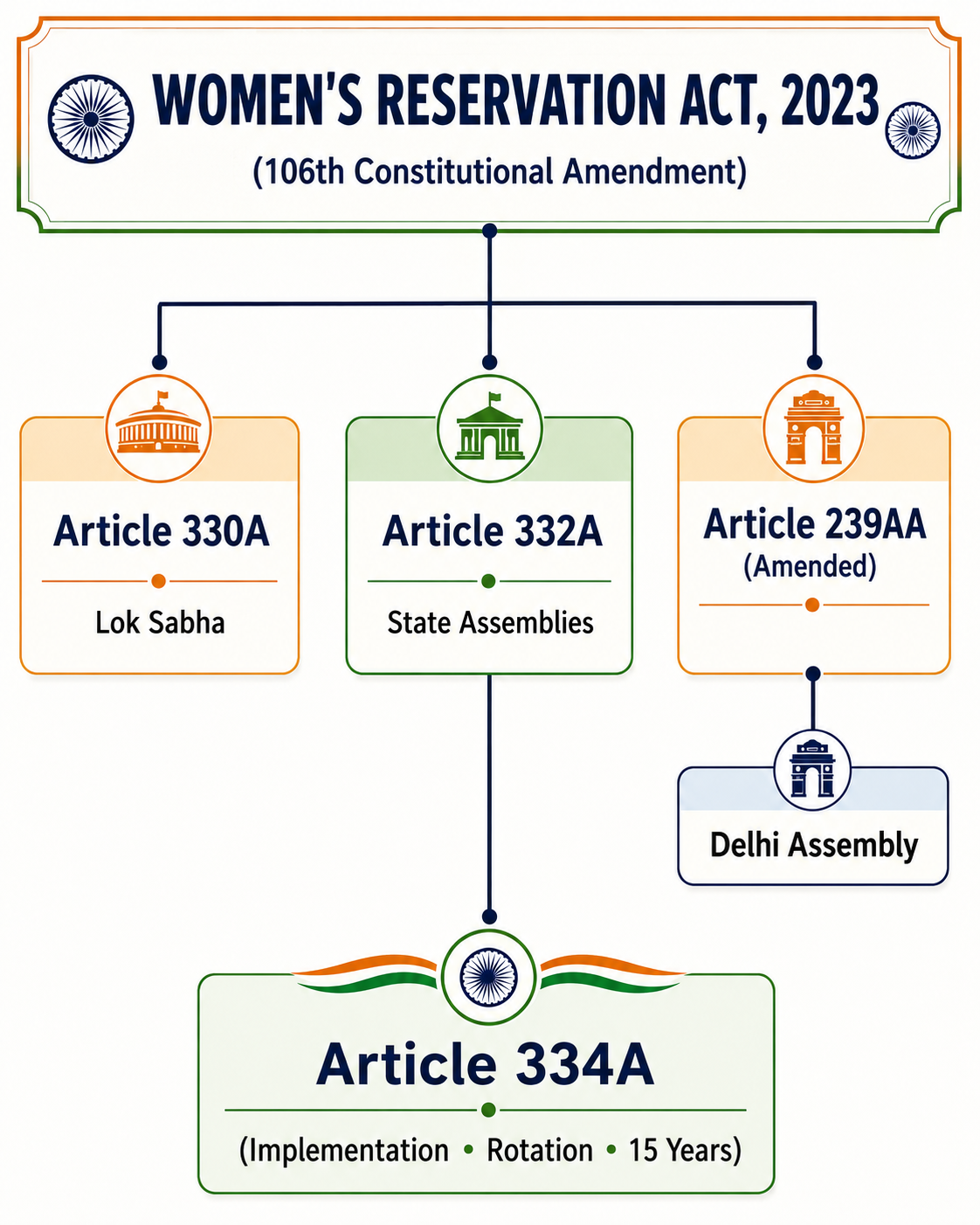
Summary Table of Constitutional Changes
| Provision | What It Does |
| Article 239AA (amended) | One-third women’s reservation in the Delhi Legislative Assembly |
| Article 330A (new) | One-third women’s reservation in the Lok Sabha, including within SC/ST seats |
| Article 332A (new) | One-third women’s reservation in State Legislative Assemblies, including within SC/ST seats |
| Article 334A (new) | Commencement after Census + delimitation; 15-year sunset clause; rotation of seats |
How the 2023 Act Differs From the 2008 Bill
The 2008 Bill, passed by the Rajya Sabha in 2010, contained no precondition linking implementation to a Census or delimitation — reservation could have applied from the next general election. The 2023 Act, by contrast, ties commencement to both processes. It also fixes the 15-year period from the Act’s commencement rather than from the date reservation actually begins, and leaves rotation details to future parliamentary law.
Criticisms and Concerns
- Delayed implementation: Because rollout depends on the Census and delimitation, the reservation could not apply in 2024, and without changes may not materialise until the 2029 election — or later.
- No OBC sub-quota: As the Geeta Mukherjee Committee noted decades ago, women from Other Backward Classes receive no dedicated share, since the Constitution provides no OBC seat reservation in legislatures.
- Rotation and accountability: Rotating reserved constituencies every delimitation cycle may weaken an MP’s incentive to invest in their constituency long term.
- Federal concerns over delimitation: Southern states worry that a population-based delimitation could reduce their relative share of Lok Sabha seats, effectively penalising states that succeeded at population control.
- No Rajya Sabha coverage: Women’s representation in the upper Houses remains unaddressed.
Where Things Stand in 2026: Census, Delimitation and the Road to Implementation
The implementation question has dominated political debate through 2025-26. The government announced that the Population Census 2027 — which will include caste enumeration — will be conducted with a reference date of 1 March 2027. Under the Act’s original scheme, delimitation based on this Census would precede the women’s quota, with official indications that the reservation could be operational by the 2029 Lok Sabha election.
However, in 2026 the government signalled a possible delinking of women’s reservation from the 2027 Census, exploring an early rollout using 2011 Census data for delimitation — a move that could expand the Lok Sabha significantly (proposals discussed in public debate mention an increase from 543 towards roughly 800+ seats, with around 270+ reserved for women). Opposition parties have pushed back, arguing that delimitation should follow a fresh census including caste data, and renewing the demand for an OBC quota within the women’s quota. If no new formula is adopted, analysts note the default timeline could push actual implementation to 2034. The matter is expected to return to Parliament in upcoming sessions.
Significance of the Women’s Reservation Act
Whenever implemented, the 106th Amendment will be transformative. It will nearly double or triple women’s presence in the Lok Sabha and State Assemblies, institutionalise women’s voice in national law-making, and build on India’s grassroots success with Panchayat-level reservation. Research on women representatives in local government suggests they invest more in public goods like water, health and education — outcomes the national quota hopes to replicate at scale.
Why this topic is important for UPSC and APSC:
The Women’s Reservation Act, 2023 is an important topic for both UPSC and APSC as it connects constitutional provisions, gender justice, political empowerment, and democratic representation. The Act highlights India’s approach towards inclusive governance and addresses issues related to equality, affirmative action, and electoral reforms. Understanding its provisions, implementation challenges, and criticisms helps in analysing contemporary constitutional and social justice issues.
Relevant Papers:
- UPSC GS Paper II & APSC General Studies Paper II (Polity, Governance, Constitution and Social Justice): Constitutional amendments, Articles 330A, 332A, 334A, women’s political representation, and electoral reforms.
- UPSC Essay Paper & APSC Essay Paper: Themes related to gender equality, women empowerment, and inclusive development.
APSC MAINS GS PAPER -II PYQ (2024)
Q. What are the key provisions and constitutional challenges associated with the Women’s Reservation Act, 2023 (106th Constitutional Amendment Act)? (15 Marks)
The Women’s Reservation Act, 2023, popularly known as the Nari Shakti Vandan Adhiniyam, seeks to strengthen women’s political representation by reserving one-third of seats in the Lok Sabha, State Legislative Assemblies, and the Delhi Legislative Assembly. It is a landmark step towards realizing the constitutional vision of substantive equality under Articles 14, 15 and 16.
Key Provisions of the Women’s Reservation Act, 2023
1. One-third reservation for women
- Reserves 33% of seats in the Lok Sabha, State Legislative Assemblies and Delhi Legislative Assembly.
2. Reservation within SC/ST quota
- One-third of seats already reserved for Scheduled Castes (SCs) and Scheduled Tribes (STs) shall also be reserved for women.
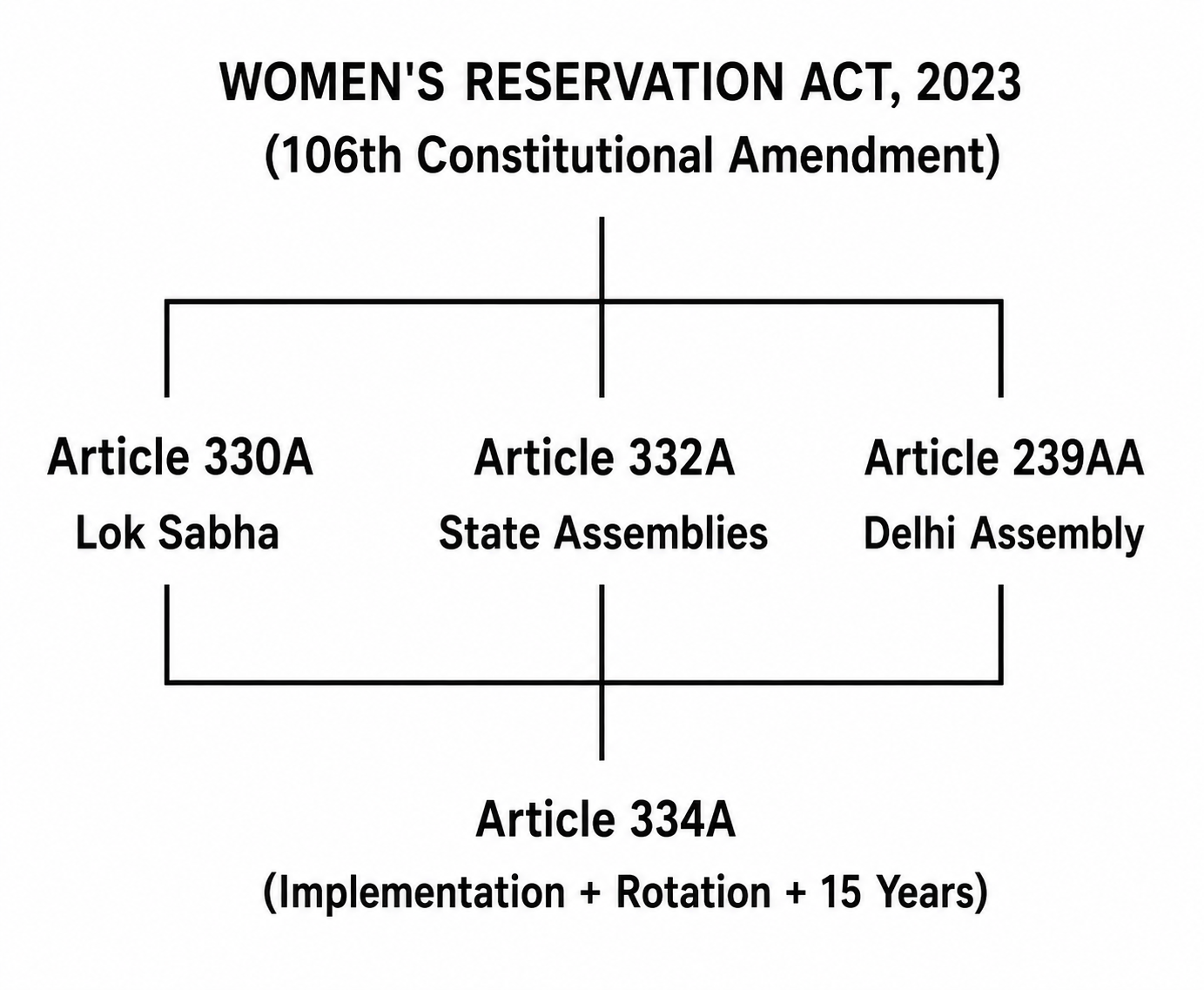
3. New Constitutional Provisions
- Article 330A: Reservation for women in the Lok Sabha.
- Article 332A: Reservation for women in State Legislative Assemblies.
- Article 334A: Provides for commencement after delimitation, rotation of seats and a 15-year duration.
- Article 239AA amended: Extends reservation to the Delhi Legislative Assembly.
4. Implementation after Census and Delimitation
- Reservation will come into effect only after the first Census conducted after the commencement of the Act and the subsequent delimitation exercise.
5. Rotation of Reserved Constituencies
- Reserved seats will rotate after every delimitation, as determined by Parliament.
6. Sunset Clause
- Reservation is valid for 15 years, unless extended by Parliament.
7. Exclusion of Rajya Sabha and Legislative Councils
- The Act applies only to directly elected legislatures and not to the Rajya Sabha or State Legislative Councils.
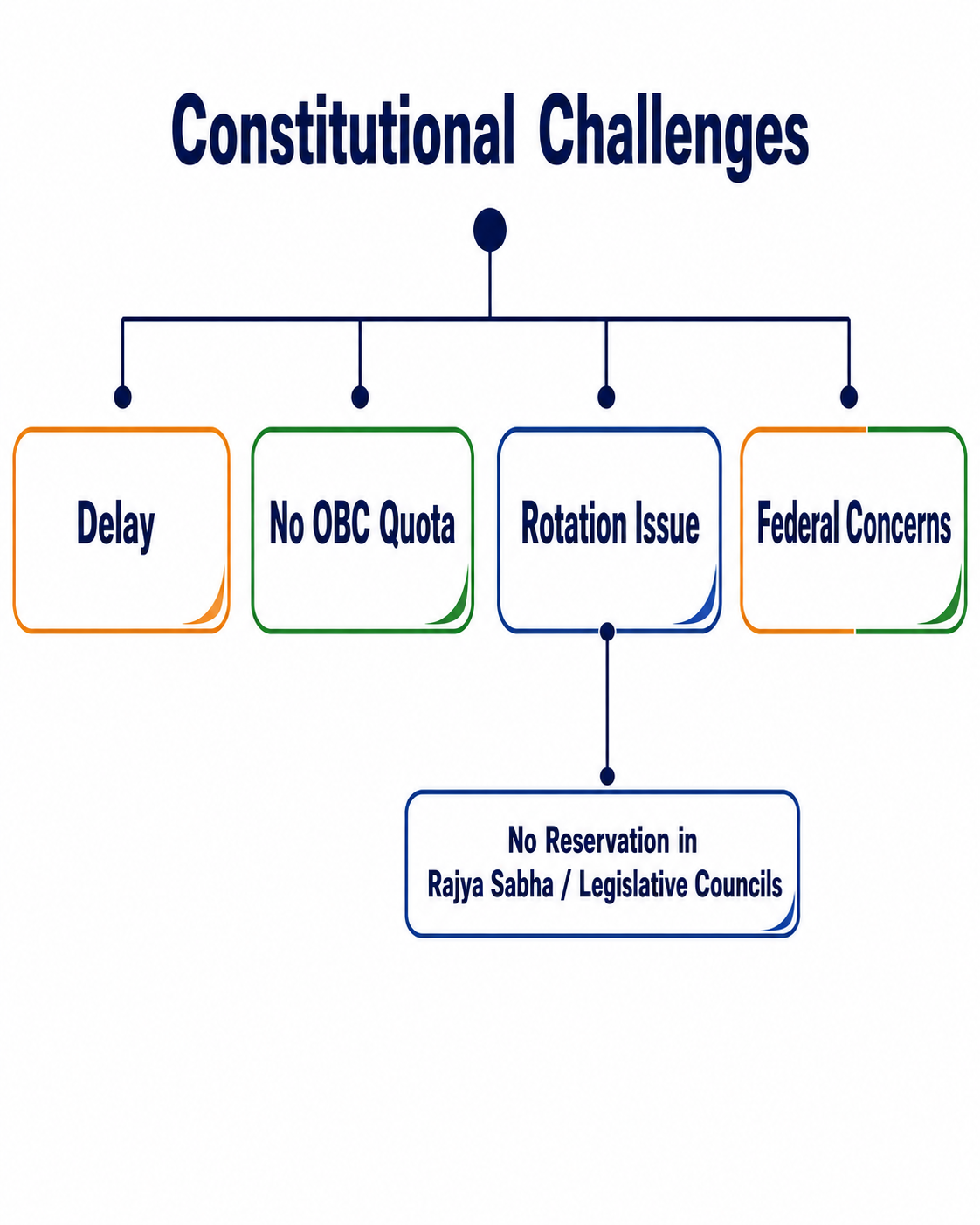
Constitutional Challenges of Women’s Reservation Bill
1. Delay in Implementation
- Linking reservation to Census and delimitation postpones the realization of women’s political rights, raising concerns regarding the constitutional principle of effective equality.
2. Absence of OBC Sub-Quota
- Unlike SC/ST women, OBC women receive no separate reservation, leading to debates on inclusive representation under Article 15(3).
3. Federal Concerns
- Delimitation based on population may alter the representation of States, especially southern States that have successfully controlled population growth, raising issues related to the federal balance.
4. Rotation of Seats
- Frequent rotation may weaken constituency accountability, discourage long-term political investment, and affect leadership continuity.
5. Exclusion of Upper Houses
- No reservation exists in the Rajya Sabha and Legislative Councils, leaving gender imbalance in important legislative institutions.
6. Democratic Representation vs Electoral Equality
- It is also argued that reserving constituencies may affect the principle of equal electoral competition, although the Supreme Court has consistently upheld affirmative action to achieve substantive equality.
Way Forward
- Conduct the Census and delimitation at the earliest to operationalize the Act.
- Consider a sub-quota for OBC women based on wider political consensus.
- Ensure transparent criteria for rotation of constituencies.
- Strengthen women’s political participation through leadership training, campaign finance support and capacity building, beyond constitutional reservation.
Conclusion
The Women’s Reservation Act, 2023 is a transformative constitutional reform. It aims at making Indian democracy more representative and inclusive. However, its success depends upon timely implementation, cooperative federalism and inclusive political participation, ensuring that reservation translates into meaningful empowerment rather than symbolic representation.
নাৰী তুমি অৰ্ধ আকাশ