

The history of ancient Assam, known in early sources by names such as Pragjyotisha and Kamarupa, is reconstructed through a rich body of literary, religious, geographical and foreign accounts. Unlike later Assam, where the Buranjis provide extensive historical narratives, the early history of the Brahmaputra Valley must be pieced together from Vedic texts, the Mahabharata, Ramayana, Puranas, Tantric literature, Sanskrit court poetry, chronicles and Chinese travel accounts.
These literary sources of ancient Assam provide valuable information about the region’s geography, political authority, religious traditions, economy, trade, military power and diplomatic relations. However, since many of these texts combine historical traditions with mythology and religious narratives, historians compare them with epigraphic evidence and archaeological findings to establish a reliable chronology.
What Are the Major Literary Sources of Ancient Assam?
The major literary sources for reconstructing ancient Assam can broadly be classified into five groups:
- Vedic and Brahmanical literature
- The Mahabharata and Ramayana
- Puranic and Tantric texts
- Classical Sanskrit and secular literature
- Foreign accounts and travelogues
Together, these sources help trace the evolution of Pragjyotisha and Kamarupa, from their early geographical and mythological references to the historically documented kingdom of Kamarupa.
What Do Vedic Texts Tell Us About Ancient Assam?
Vedic literature provides some of the earliest references to the eastern frontier of the Indo-Aryan cultural world.
What Does the Satapatha Brahmana Say About the Eastern Frontier?
The Satapatha Brahmana describes the eastward movement of Vedic culture associated with Videgha Mathava. Its reference to the river Sadanira, traditionally associated with the Karatoya, is important for understanding the eastern limits of early Vedic geography.
The text does not provide a detailed political history of Assam, but its geographical references help historians understand the changing cultural frontier toward eastern India.
What Do the Aitareya and Gopatha Brahmanas Mention?
The Aitareya Brahmana and Gopatha Brahmana contain references to eastern communities and frontier peoples. These accounts reflect the cultural distinction between the established Vedic heartland and the societies inhabiting the eastern regions.
Although their references to Assam are limited, they are useful when studying the broader historical context of ancient Pragjyotisha and eastern India.
What Does the Mahabharata Tell Us About Pragjyotisha?
The Mahabharata is one of the most important literary sources associated with the early traditions of Pragjyotisha.
It refers to Pragjyotisha as a powerful eastern kingdom and associates it with the legendary ruler Bhagadatta, who is portrayed as an ally of the Kauravas during the Kurukshetra War.
Bhagadatta is particularly associated with his formidable war elephant Supratika and is described as commanding warriors identified with groups such as the Kiratas and Cinas.
The Mahabharata’s accounts are deeply intertwined with epic tradition, but they are significant because they demonstrate that Pragjyotisha occupied an identifiable place in the geographical imagination of early Indian literature.
Who Were Narakasura and Bhagadatta in the Pragjyotisha Tradition?
The tradition of the Naraka or Bhauma dynasty occupies an important place in the literary history of Assam.
Narakasura is traditionally associated with the establishment of Pragjyotisha and its royal lineage, while Bhagadatta, presented as his descendant, appears prominently in the Mahabharata.
These traditions later became central to the political and religious narratives surrounding Kamarupa and Kamakhya.
What Does the Ramayana Say About Pragjyotisha?
The Ramayana, particularly the Kishkindha Kanda, contains references to Pragjyotisha among the eastern regions described in its geographical narrative.
The epic portrays the region as a distant and formidable eastern territory. Although these descriptions should be interpreted cautiously because of the epic’s mythological character, they are useful for understanding how Pragjyotisha was represented in early Indian geographical traditions.
What Do the Puranas Tell Us About Kamarupa?
Puranic literature provides important information about the sacred geography, royal traditions and religious identity of Kamarupa.
Texts such as the Kalika Purana, Vishnu Purana and Garuda Purana preserve traditions concerning the region’s rulers, sacred places and geographical boundaries.
Among these, the Kalika Purana is particularly significant for understanding the religious landscape of medieval Kamarupa.
Why Is the Kalika Purana Important for the History of Assam?
The Kalika Purana, generally dated to the early medieval period, is one of the most important textual sources for the religious history of Kamarupa.
It connects the region with the worship of Kamakhya, Shakti traditions and the broader sacred geography of Kamarupa.
The text also preserves traditions surrounding Naraka, the transformation of Pragjyotisha into Kamarupa in religious mythology, and the integration of different cultural traditions into the region’s royal ideology.
Its significance lies particularly in demonstrating how religion, kingship and sacred geography became closely connected in medieval Kamarupa.
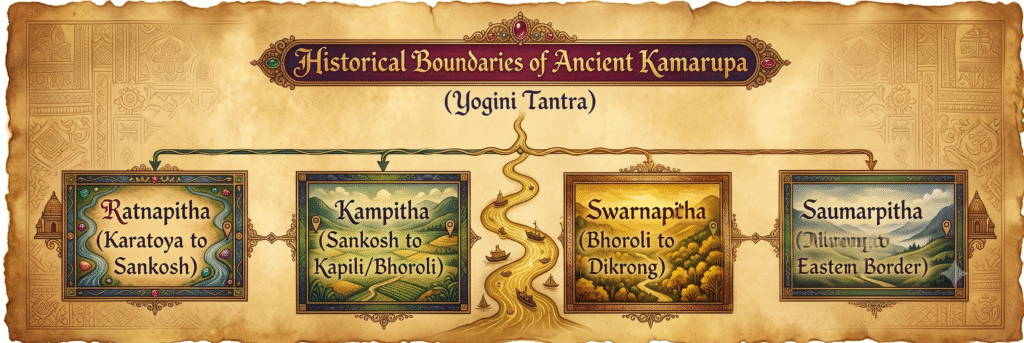
How Does the Yogini Tantra Describe the Boundaries of Kamarupa?
The Yogini Tantra, composed considerably later than the earliest historical sources, preserves an influential geographical tradition that divides Kamarupa into four Pithas:
| Pitha | Traditional Extent |
| Ratnapitha | Karatoya to Sankosh |
| Kampitha | Sankosh to Kapili/Bhoroli |
| Swarnapitha | Bhoroli to Dikrong |
| Saumarpitha | Dikrong towards the eastern limits |
This fourfold division is particularly important in discussions of the traditional boundaries of Kamarupa.
However, because the Yogini Tantra is a later text, its geographical description should not automatically be treated as a precise political map of an earlier historical period.
What Does Kautilya’s Arthashastra Reveal About Assam’s Economy?
The Arthashastra, attributed to Kautilya, is an important source for understanding the economic geography of ancient India.
Its references to products associated with the Lauhitya (Brahmaputra) region are significant for understanding Assam’s position within wider trade networks.
The eastern region was associated with valuable commodities including:
- Fine textiles
- Silk and silk-like fabrics
- Forest products
- Aromatic substances
- Agarwood
- Medicinal and other forest commodities
These references suggest that the Brahmaputra Valley and its surrounding regions participated in long-distance commercial networks connecting eastern India with other parts of the subcontinent.
What Does Kalidasa’s Raghuvamsha Say About Kamarupa?
The Raghuvamsha, attributed to Kalidasa, contains an important reference to the eastern campaign of King Raghu.
The account associates the ruler of Kamarupa with the payment of tribute and particularly highlights war elephants.
The reference is significant because elephants became one of the recurring markers of Assam’s military and economic importance in classical Indian literature.
What Does Harshacharita Tell Us About Bhaskaravarman?
The Harshacharita of Banabhatta provides some of the most valuable literary evidence for 7th-century Kamarupa.
It refers to King Bhaskaravarman, one of the most historically significant rulers of ancient Kamarupa, and his diplomatic relationship with Harshavardhana of Kannauj.
The text records the arrival of the Kamarupa envoy Hamsavega, reflecting the diplomatic importance of Bhaskaravarman’s kingdom.
Banabhatta also mentions gifts and objects associated with the Kamarupa court, including textiles, ornaments, vessels and manuscripts.
This makes the Harshacharita particularly valuable for understanding Kamarupa’s diplomacy, court culture and material life during the 7th century CE.
What Does Rajatarangini Tell Us About Kamarupa?
Kalhana’s Rajatarangini, a 12th-century Sanskrit chronicle of Kashmir, preserves a tradition connecting Kamarupa with the western Himalayan political world.
It mentions Princess Amritaprabha of Kamarupa and her marriage to Meghavahana of Kashmir.
The account is useful for studying the diplomatic and cultural connections between Kamarupa and regions far beyond the Brahmaputra Valley.
What Do Foreign Travellers Tell Us About Ancient Kamarupa?
Foreign accounts provide an important external perspective on ancient Assam.
Among the most significant sources are the writings of Xuanzang (Hiuen Tsang) and Hwui Li, whose accounts relate directly to 7th-century Kamarupa.
| Source | Period | Importance for Ancient Assam |
| Periplus of the Erythraean Sea | 1st century CE | Provides information relevant to eastern trade networks and commodities |
| Ptolemy’s Geographia | 2nd century CE | Offers geographical information about eastern India |
| Xuanzang’s travel account | 7th century CE | Describes Kamarupa, its ruler, society and religious conditions |
| Hwui Li’s Life of Hiuen-Tsiang | 7th century CE | Provides additional information about Xuanzang’s journey and royal connections |
| Tabaqat-i-Nasiri | 13th century CE | Records the failed invasion of Kamarupa associated with Bakhtiyar Khalji |
What Did Xuanzang Record About Kamarupa?
The Chinese Buddhist pilgrim Xuanzang visited Kamarupa during the reign of Bhaskaravarman in the 7th century CE.
His account is one of the most important contemporary external sources for the history of ancient Assam.
Xuanzang described Kamarupa as a large and prosperous kingdom and provided observations concerning:
- Its geographical extent
- Agriculture and natural resources
- Political administration
- Religious practices
- The position of Buddhism
- The character of its people
- The influence of King Bhaskaravarman
His account is particularly valuable because it provides an external contemporary description of Kamarupa rather than relying exclusively on later regional traditions.
What Does the Tabaqat-i-Nasiri Tell Us About Kamarupa?
The Tabaqat-i-Nasiri, written by Minhaj-i-Siraj in the 13th century, provides an important account of the failed expedition of Muhammad Bakhtiyar Khalji into the region in 1206 CE.
The account marks an important transition between the classical history of Kamarupa and the political developments of medieval Assam.
References to difficult terrain, rivers and defensive structures also highlight the geographical challenges faced by invading armies entering the Brahmaputra Valley.
Why Must Literary Sources Be Compared With Epigraphic Evidence?
Literary sources are indispensable for reconstructing ancient Assam, but they cannot always be treated as straightforward historical records.
Epic and Puranic texts frequently combine:
- Mythology
- Religious traditions
- Genealogies
- Political ideology
- Geographical descriptions
- Historical memories
Therefore, historians compare literary accounts with epigraphic evidence to establish a more reliable chronology.
Important inscriptions and copperplate records include the Umachal Rock Inscription, Dubi Copperplate, Nidhanpur Copperplate, and inscriptions associated with the Salastambha and Pala rulers of Kamarupa.
When literary narratives and inscriptions are studied together, they provide a stronger basis for reconstructing the political history, territorial evolution, economy and religious traditions of ancient Assam.
What Is the Historical Importance of Literary Sources of Ancient Assam?
The literary sources of ancient Assam collectively reveal a region that was far from isolated. Pragjyotisha and Kamarupa were connected with wider networks of trade, warfare, diplomacy and religious exchange across the Indian subcontinent.
From the epic traditions surrounding Naraka and Bhagadatta to the historically documented reign of Bhaskaravarman, these sources show the gradual evolution of the region’s political and cultural identity.
For students preparing APSC and UPSC, the key takeaway is that the history of ancient Assam must be reconstructed through multiple sources rather than a single text. Vedic literature provides early geographical context, epics preserve political and cultural traditions, Puranas and Tantric texts illuminate sacred geography, Sanskrit literature records diplomacy and court culture, while foreign travellers offer valuable external observations.
Together with inscriptions and archaeological evidence, these literary sources form the textual foundation for understanding the history of Pragjyotisha and Kamarupa.
Source – Assam History
Also read –
Literary Sources of Ancient Assam
What are the major literary sources of ancient Assam?
The major literary sources of ancient Assam include the Mahabharata, Ramayana, Kalika Purana, Yogini Tantra, Arthashastra, Harshacharita, Rajatarangini and accounts of foreign travellers such as Xuanzang.
What do literary sources tell us about Pragjyotisha and Kamarupa?
The literary sources of ancient Assam provide information about Pragjyotisha and Kamarupa’s geography, rulers, religion, trade, diplomacy, military power and cultural traditions.
Why are literary sources important for ancient Assam history?
The literary sources of ancient Assam help historians reconstruct the region’s early history, especially when studied alongside inscriptions, copperplates and archaeological evidence.