

Why NCERTs Are the Backbone of UPSC Preparation
When it comes to UPSC Civil Services Examination preparation, no resource is more fundamental than NCERT textbooks. Every experienced UPSC mentor, IAS officer, and top-ranked aspirant will tell you the same thing: NCERTs are non-negotiable. Yet, thousands of aspirants either skip them entirely or read them the wrong way — losing out on one of the easiest opportunities to build a solid foundation.
At Borthakur’s IAS Academy, we have mentored hundreds of successful UPSC candidates, and one pattern is consistent across toppers: they read their NCERTs with discipline, strategy, and purpose. This comprehensive guide will walk you through exactly how to read NCERTs for UPSC — from which books to pick, to how many times to read them, and how to convert that reading into high-scoring answers.
| Quick Insight: According to UPSC toppers’ interviews, approximately 40-60% of Prelims questions can be traced directly or indirectly to NCERT concepts. A strong NCERT foundation is your fastest route to clearing the Prelims cutoff. |
What Are NCERTs and Why Do They Matter for UPSC?
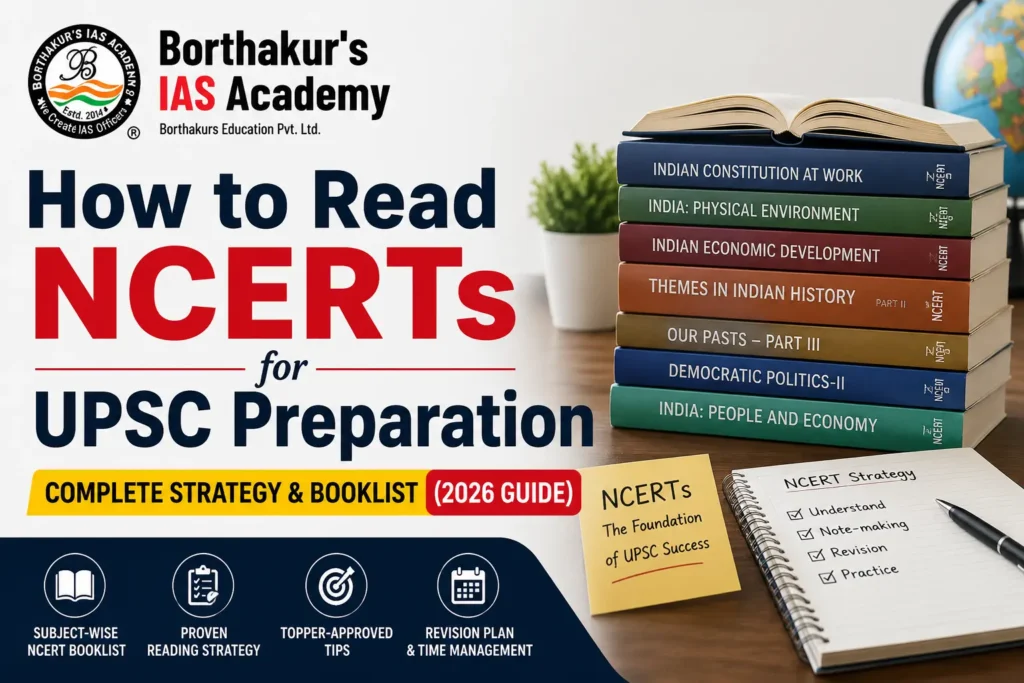
NCERT (National Council of Educational Research and Training) textbooks are standard school-level books published by the Indian government for classes 6 to 12. They are written in simple, precise language and cover the core concepts of subjects like History, Geography, Political Science, Economics, Science, and Environment.
For UPSC aspirants, these books serve multiple critical purposes:
- They establish conceptual clarity on complex topics in simple language
- They are the primary source material that UPSC question-setters refer to
- They help build a common baseline that advanced books like Laxmikanth and Bipin Chandra build upon
- They are concise, making them ideal for quick revision during the final months before the exam
- They help you answer answer-writing questions in the Mains with structured, factual accuracy
Which NCERT Books to Read for UPSC — Subject-Wise List
Not all NCERT books are equally important for UPSC. Based on our experience at Borthakur’s IAS Academy, here is a curated subject-wise list of the most important NCERTs:
History
- Class 6 — Our Pasts Part I
- Class 7 — Our Pasts Part II
- Class 8 — Our Pasts Part III
- Class 10 — India and the Contemporary World II (Nationalism in India)
- Class 11 — Themes in World History
- Class 12 — Themes in Indian History Parts I, II & III (Old NCERTs by Satish Chandra & R.S. Sharma are also highly recommended)
Geography
- Class 6 — The Earth: Our Habitat
- Class 7 — Our Environment
- Class 8 — Resources and Development
- Class 11 — Fundamentals of Physical Geography
- Class 11 — India: Physical Environment
- Class 12 — Fundamentals of Human Geography
- Class 12 — India: People and Economy
Political Science / Polity
- Class 9 — Democratic Politics I
- Class 10 — Democratic Politics II
- Class 11 — Indian Constitution at Work
- Class 11 — Political Theory
- Class 12 — Contemporary World Politics
- Class 12 — Politics in India Since Independence
Economics
- Class 9 — Economics (Understanding Economic Development)
- Class 10 — Understanding Economic Development
- Class 11 — Indian Economic Development
- Class 12 — Macroeconomics (Introductory)
- Class 12 — Microeconomics (Introductory)
Science & Environment
- Class 6 to 10 — Science (especially Biology chapters)
- Class 11 & 12 — Biology (selected chapters on Ecology and Environment)
Sociology (Optional but Useful)
- Class 11 — Introducing Sociology
- Class 12 — Indian Society
| Pro Tip from Borthakur’s IAS Academy: Do NOT read all NCERT books back-to-back. Prioritize Class 11 and 12 books first for breadth, then go back to Class 6-10 books for foundational understanding. This top-down approach builds context before detail. |
Old NCERTs vs New NCERTs: Which Should You Read?
This is one of the most debated questions among UPSC aspirants. The answer depends on the subject:
For History — Read Both
Old NCERTs by R.S. Sharma (Ancient India), Romila Thapar (Medieval India), and Bipan Chandra (Modern India and Freedom Struggle) are considered gold standards for UPSC History. New NCERTs are more thematic and analytical but may miss some factual depth. Ideally, cover old NCERTs for Modern History and supplement with new NCERTs.
For Geography and Polity — New NCERTs are Sufficient
The new NCERT Geography and Polity books are comprehensive, updated, and well-structured. Stick to these and you will be well-prepared.
For Economics — New NCERTs Are Preferred
The new NCERT Economics books (Class 11 and 12) are excellent for building a strong conceptual base in both micro and macro topics relevant to GS Paper III.
How Many Times Should You Read NCERTs?
This is where most aspirants go wrong. Reading NCERTs once is never enough. Here is the recommended reading cycle followed at Borthakur’s IAS Academy:
First Reading — Understanding (Active Reading)
Your first read should be a thorough, slow, and attentive read. Do not skip anything. Underline key terms, facts, dates, and concepts. Write brief margin notes in your own words. The goal here is comprehension, not memorization.
Second Reading — Note-Making
In the second reading, consolidate your notes. Create topic-wise notes that you can revise quickly. Use headers, bullet points, and short sentences. Map concepts to current affairs wherever possible. This reading should be 20-30% faster than the first.
Third Reading — Revision
The third reading is for revision. This should happen at least 2-3 months before the Prelims. Only read your notes and underlined portions. Focus on areas where you feel less confident. This reading should be very fast — almost scanning.
Fourth Reading (Optional) — Pre-Exam Brush-Up
A quick last-minute brush-up 1-2 weeks before the exam is highly recommended. At this point, you should only be going through your short notes and high-yield pages.
| Borthakur’s IAS Academy Mantra: Read NCERTs at least 3 times. First time to understand. Second time to note. Third time to revise. Consistency beats intensity every time. |
Step-by-Step Strategy to Read NCERTs Effectively
Here is the structured, proven methodology we teach at Borthakur’s IAS Academy:
Step 1: Set a Reading Schedule
Create a realistic timetable. Allocate subject-wise slots across your week. For example:
- Monday & Tuesday — History NCERTs
- Wednesday — Geography NCERTs
- Thursday — Polity NCERTs
- Friday — Economics NCERTs
- Saturday — Science/Environment NCERTs
- Sunday — Revision and Note Consolidation
Step 2: Read Actively, Not Passively
Do not read NCERTs like a novel. Read with a pencil in hand. Ask yourself after every paragraph: ‘What is the key idea here?’ and ‘How does this connect to what I already know?’ Mark important facts, dates, and terms.
Step 3: Take Smart Notes
Smart note-taking is the difference between retaining 30% and 70% of what you read. Follow these rules:
- Write in your own words, not copy-paste from the book
- Use frameworks: Causes, Effects, Significance, Present Relevance
- For Geography, draw and label maps alongside your notes
- For History, create timelines
- For Economics, draw flowcharts for concepts
Step 4: Connect to UPSC PYQs
After finishing each chapter, review the previous year UPSC Prelims and Mains questions from that chapter. This will give you a sense of how UPSC uses NCERT content and what level of detail is expected.
Step 5: Link NCERTs to Current Affairs
NCERTs provide the static foundation; current affairs provide the dynamic layer. Every major current affairs topic links back to an NCERT concept. For example, the tribal rights issues in news connect to Polity NCERTs on fundamental rights and constitutional provisions for tribals.
Step 6: Self-Test After Every Chapter
After finishing a chapter, close the book and try to recall the main points from memory. Write them down. Compare with your notes. This active recall method dramatically improves long-term retention.
Subject-Wise NCERT Reading Tips for UPSC
History NCERTs
- Focus on themes, movements, and socio-economic changes — not just dates
- For Ancient India, understand art, culture, religion, and administration
- For Medieval India, focus on Bhakti-Sufi movements, regional kingdoms, and Mughal administration
- For Modern India, master the freedom struggle, social reform movements, and important Acts
- Create a running timeline of important events from 1857 to 1947
Geography NCERTs
- Always read with an atlas open beside you
- Mark important physical features, rivers, mountain ranges, and passes on a blank map
- Understand monsoon mechanism, ocean currents, and plate tectonics conceptually
- Link human geography concepts to India’s development challenges
- Make a table of all important biomes, climate types, and soil types
Polity NCERTs
- Read in conjunction with Laxmikanth for depth, but start with NCERT for basics
- Focus on constitutional provisions, fundamental rights, and DPSP
- Note the differences between various types of bills, amendments, and schedules
- Understand the federal structure, Centre-State relations, and Emergency provisions
Economics NCERTs
- Master basic terms: GDP, GNP, NNP, inflation, fiscal deficit, CAD
- Understand the Five Year Plan framework and current economic policies
- Focus on agriculture, industry, and service sector challenges in India
- Read Class 12 Macro and Microeconomics carefully — UPSC loves these concepts
Science and Environment NCERTs
- From Class 6-10 Science, focus on Biology (Life Sciences and Ecology)
- Cover topics like photosynthesis, food chain, ecosystem, biodiversity
- From Class 11-12, cover environmental ecology, environmental laws, and climate change
- Note important environmental conventions: Kyoto Protocol, Paris Agreement, Ramsar Convention
Common Mistakes Aspirants Make While Reading NCERTs
At Borthakur’s IAS Academy, we have observed several recurring mistakes that cost aspirants marks. Avoid these at all costs:
- Reading NCERTs only once and moving on — This is the single biggest mistake. NCERTs must be revisited multiple times.
- Skipping Class 6-10 books — These are foundational and carry important basic concepts that Class 11-12 books assume you already know.
- Making too many notes — Some aspirants write 50 pages of notes per NCERT book. This is counterproductive. Keep notes concise and to the point.
- Reading NCERTs in isolation from current affairs — NCERTs without current affairs linkage are only half as effective.
- Not solving PYQs chapter-wise — UPSC PYQs reveal exactly what the examiner looks for from each NCERT topic.
- Reading sequentially without prioritization — Prioritize the most important NCERT books first and then fill in the rest.
- Ignoring maps, diagrams, and tables — These are frequently tested in UPSC Prelims. Study them carefully.
NCERT Reading Schedule: A Monthly Plan for UPSC Aspirants
Here is a realistic 4-month NCERT reading plan for full-time UPSC aspirants:
Month 1: History and Geography
- Week 1-2: Complete all History NCERTs (Class 6-12)
- Week 3-4: Complete all Geography NCERTs (Class 6-12)
- Daily: Solve 5-10 MCQs from the chapters covered
Month 2: Polity, Economics, and Science
- Week 1: Complete Polity NCERTs (Class 9-12)
- Week 2: Complete Economics NCERTs (Class 9-12)
- Week 3-4: Complete Science NCERTs (Class 6-12, selected chapters)
- Daily: Write brief notes and attempt PYQs
Month 3: First Revision Cycle
- Revisit all subject notes made in Month 1 and 2
- Integrate current affairs with NCERT themes
- Take mock tests based on NCERT content
- Strengthen weak areas identified from mock tests
Month 4: Second Revision and Integration
- Final revision of all NCERT notes
- Solve full-length mock tests
- Revise high-yield topics: Freedom Struggle, Indian Geography, Polity Basics, Economic Terms
- Prepare short flashcards for last-minute review
| Time-Saving Tip: Use the ‘three-pass reading method’ — first pass for understanding (slow), second pass for note-making (medium speed), third pass for revision (fast). Each subsequent pass should take 50% less time than the previous one. |
How to Use NCERTs for UPSC Mains Answer Writing
NCERT reading is not just for Prelims. For the UPSC Mains examination, NCERTs play a crucial supporting role:
- They provide factual accuracy and precise definitions for your answers
- They help structure your answers with the right terminology
- Historical and geographical knowledge from NCERTs enriches your GS Paper I answers
- Economic and political theory from NCERTs supports strong GS Paper II and III arguments
- For Essay paper, NCERT examples add credibility and grounding to abstract arguments
When writing Mains answers, cite NCERT concepts as the conceptual foundation and then layer with advanced analysis from books like Laxmikanth, Bipin Chandra, or Ramesh Singh. This combination of basic accuracy with advanced analysis is what distinguishes top scorers.
Best Tools and Resources to Supplement NCERT Reading
At Borthakur’s IAS Academy, we recommend the following resources to complement your NCERT reading:
Books to Read After NCERTs
- History: Bipin Chandra’s ‘India’s Struggle for Independence’ and ‘India After Independence’
- Polity: M. Laxmikanth’s ‘Indian Polity’
- Geography: G.C. Leong’s ‘Certificate Physical and Human Geography’
- Economics: Ramesh Singh’s ‘Indian Economy’
- Environment: Shankar IAS Environment Book
Digital Resources
- NCERT e-books available free at ncert.nic.in
- UPSC official website for previous year question papers
- Borthakur’s IAS Academy YouTube channel and study materials for NCERT summaries and chapter analyses
- Mrunal.org for Economy NCERT integration with current affairs
Conclusion: Build Your Foundation, Build Your Future
NCERTs are not just school textbooks — they are the launchpad for your UPSC success. Aspirants who take NCERTs seriously and read them the right way consistently outperform those who jump directly to advanced resources.
At Borthakur’s IAS Academy, we believe that the UPSC journey is a marathon, not a sprint. Start with a strong NCERT foundation, read smartly and consistently, link your reading to current affairs, and revise multiple times. This is the tried-and-tested formula that our successful students follow year after year.
Remember: Every IAS officer you admire began where you are — with a Class 6 NCERT in hand. The difference is how seriously they read it.
| Ready to start your UPSC journey the right way? Borthakur’s IAS Academy offers structured NCERT-based foundation courses, mentorship programs, and UPSC guidance tailored for aspirants from Northeast India and across the country. Contact us today to know more about our programs. |
About Borthakur’s IAS Academy
Borthakur’s IAS Academy is a premier UPSC coaching institute dedicated to helping civil services aspirants achieve their dreams. With experienced faculty, a structured curriculum, and a proven track record of results, we provide comprehensive preparation for the IAS, IPS, IFS, and other UPSC examinations. Our teaching methodology combines strong foundational learning from NCERTs with advanced analytical thinking required to crack one of India’s most competitive exams.